

This article is Part 2 of 4 in our Emotional Risk Economies series, a framework that explores how different categories operate under distinct emotional contracts on social media. Each installment examines the structural pressures, audience psychology, and platform incentives shaping brand risk in real time.
Emotional Risk Economies Universe: Part 1: Trust Economy || Part 2: Alignment || Part 3: Prestige
When Identity Becomes Infrastructure
Some brands are evaluated on competence. Others are evaluated on safety and reliability. A smaller, more volatile group is evaluated on belief. That distinction is not aesthetic. It is structural, and it fundamentally changes how audiences interpret behavior.
In the Alignment Economy, customers are not simply purchasing a product or service. They are participating in a worldview. The exchange carries ideological weight, which means routine marketing decisions are no longer routine. Partnerships become endorsements. Hiring decisions become signals. Silence becomes positioning. The tolerance for contradiction shrinks quickly because the relationship is not transactional at its core. It is expressive.
This dynamic is accelerating because platforms reward expressive identity while audiences audit for coherence. Performance is easy to manufacture in short bursts. Alignment requires institutional consistency.
What’s Happening?
Over the last decade, brands have shifted from competing primarily on product differentiation to competing on belief differentiation. The most durable growth stories in culturally relevant categories are rooted in identity density, not feature sets. That shift is playing out in governance decisions, influencer activations, labor policies, and supply chain scrutiny.

Case Study: Patagonia and Governance as Messaging
Patagonia does not treat environmentalism as a campaign theme. The company’s environmental stance is embedded in its corporate structure. When founder Yvon Chouinard transferred ownership of the company to a trust and nonprofit designed to ensure profits support climate initiatives, governance itself became brand expression.
Audience psychology in this instance is clear. Customers who buy Patagonia are not only buying outerwear. They are buying participation in a belief system about environmental stewardship. When ownership structure aligns with messaging, coherence compounds. The move signaled that the brand’s values extended beyond advertising copy into capital allocation. That is alignment functioning at the institutional level.

Case Study: TOMS, Bombas, and Embedded Giving
TOMS popularized the modern one-for-one model. Buy a pair of shoes. A pair is donated. The mechanism was simple, visible, and easy to repeat. The purchase was not just consumption. It was participation in impact.
Bombas applied similar logic in the essentials category. For every pair of socks sold, a pair is donated to homeless shelters. Over time, that promise became operational infrastructure, not campaign copy. Product design decisions were made with donation durability in mind. The giving model was not a quarterly initiative. It was the business model.
The audience psychology here is instructive. Customers are not evaluating these brands on performance alone. They are evaluating moral consistency. When a brand ties revenue directly to social good, it raises the cost of contradiction. Any labor issue, sourcing scandal, or dilution of the give-back promise would not register as a routine operational mistake. It would register as betrayal.
These brands demonstrate the upside of alignment when infrastructure matches narrative. The give-back mechanism is clear. The math is visible. The mission is embedded. That clarity reduces interpretive volatility because the belief system is structurally reinforced with every transaction.

Case Study: Bud Light and the Cost of Reframed Alignment
In April 2023, Bud Light sent a customized can to Dylan Mulvaney as part of a March Madness promotion tied to its broader influencer marketing efforts. The activation involved sponsored social content. What began as a relatively contained digital execution quickly became something much larger.
Recently, a social media consultant I met with described the activation as part of a wider influencer seeding push happening at the time. However, the brand’s official statements — and subsequent reporting — stopped short of formally classifying it that way. Public positioning later emphasized that it was a limited engagement rather than a coordinated campaign. The precise internal mechanics may never be fully reconciled in the public record. What ultimately mattered was not the contract structure but the perception.
Within days, the brand’s social metrics surged beyond normal volatility. On April 3, total engagements jumped to over 12,000 in a single day, up from roughly 4,900 days prior. Comment volume climbed from around 2,300 on March 31 to nearly 10,000 on April 3. By April 16, despite the brand posting nothing new, daily comments exceeded 26,000. The ratio of comments to likes skewed heavily toward discussion, signaling controversy rather than affinity.
Follower behavior shifted just as sharply. Instagram alone lost more than 5,000 followers on April 15. Across platforms, daily new follower growth flipped from positive to deeply negative, including a net loss of more than 6,300 followers in mid-April. Audience disengagement was not symbolic. It was measurable.
The stock impact followed weeks later. By May 31, BUD had fallen roughly 20 percent from pre-controversy levels, after social backlash had already peaked. Social volatility preceded financial consequence.
The backlash was not solely about inclusion. It was about perceived brand positioning. While the company later characterized the activation as a limited influencer engagement rather than a full-scale campaign, audiences experienced it as endorsement. In social ecosystems, perception outruns contract language. Once the post was framed as ideological alignment, distinctions around deal structure became irrelevant.
When leadership subsequently distanced itself from the activation, that response created a second wave of signaling. Supporters interpreted it as retreat. Critics treated the original post as confirmation of cultural shift. Engagement spiked. Stability did not.
Bud Light had long positioned itself as mass-market Americana. Sports. Familiarity. Accessibility. Its equity was built on ubiquity across difference. Once the activation was recoded as alignment, the brand was judged under a different set of emotional rules — ones it had not historically operated within.
In the Alignment Economy, perception moves first. Financial impact follows.
Case Study: Nike, Conviction, and Structural Tension
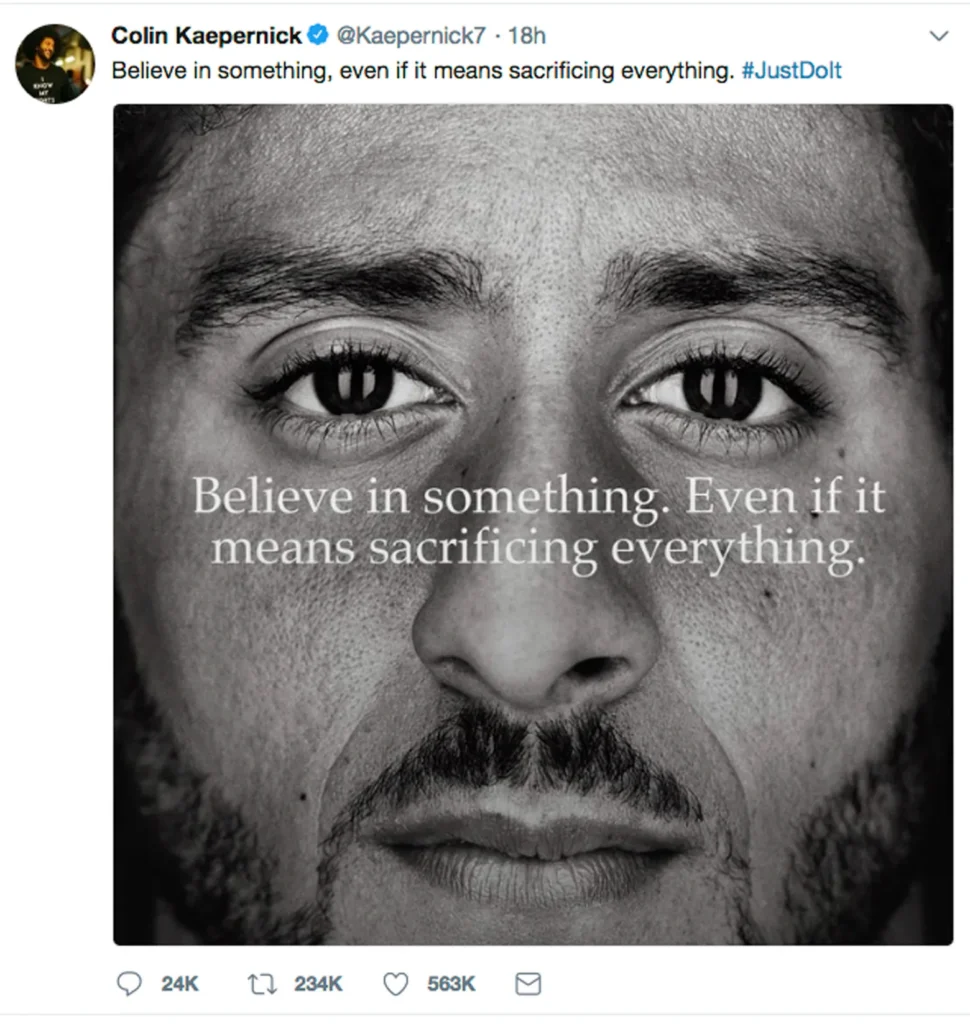
Nike’s 2018 campaign featuring Colin Kaepernick triggered immediate backlash. Public criticism surged. Boycott calls spread across social media. Political commentary intensified. Nike did not reverse course.
The campaign fit within a long-standing brand narrative centered on athlete conviction and institutional defiance. For core consumers, the controversy reinforced coherence. Online sales reportedly increased in the days following the campaign launch. Cultural heat translated into deeper loyalty.
Then came the pregnancy pay controversy.
Olympic champion Allyson Felix revealed that Nike had proposed a 70 percent pay reduction during pregnancy without guaranteeing protection against performance-based penalties. Alysia Montaño and Kara Goucher reported similar experiences. The tension was not creative. It was operational. A brand that publicly celebrates female empowerment cannot privately penalize pregnancy without scrutiny.
Nike updated its contracts to guarantee that female athletes would not be financially penalized during pregnancy for 18 months. The episode reinforced the governing rule of the Alignment Economy. Messaging invites audit. Infrastructure determines credibility.

Case Study: H&M, SHEIN, and the Limits of Optics
H&M’s “Conscious Collection” was positioned as a sustainability-forward line within a fast fashion model built on speed and scale. The messaging emphasized recycled materials and incremental sourcing improvements. On the surface, it echoed the language of alignment-first sustainability brands.
The tension was not in the copy. It was in the cadence of the business model.
Fast fashion depends on acceleration. Rapid production cycles and high SKU turnover are structural features, not marketing choices. Promoting sustainability within that velocity creates visible friction. In the Alignment Economy, operations are content. If production volume contradicts environmental messaging, audiences reconcile the inconsistency themselves, publicly.
SHEIN faced a related credibility challenge. In response to labor criticisms, the company invited influencers to tour its factories and share content from the visits. The strategy leaned on creator storytelling to signal transparency. The videos circulated widely across TikTok and Instagram.
The response was skeptical.
Many viewers interpreted the tours as reactive reputation management rather than structural change. Influencers were criticized for participation. Comment sections filled with questions about what was not shown. In identity-driven categories, influencer partnerships function as credibility multipliers. When structural alignment exists, they amplify trust. When it does not, they amplify doubt.
Transparency content cannot substitute for systemic change. In alignment categories, operational velocity becomes the headline.
Brand and Marketer Implications
Operating in the Alignment Economy narrows your margin for improvisation. Audience expectations extend beyond tone or messaging. They encompass governance, partnerships, compensation structures, sourcing, and crisis responses. Consumers in identity-dense categories scan for coherence between stated values and observable behavior.
Platform incentives complicate this further. Algorithms reward emotionally charged interpretation and decisive positioning. Creator ecosystems accelerate reframing. A routine activation can be recoded as ideological stance within hours. Once reframed, it is judged accordingly.
Institutional brands carry heavier interpretive weight than individual creators. When a creator experiments with tone, it reads as personality. When a brand experiments with tone, it reads as strategy. That asymmetry limits the margin for casual experimentation.
Engagement does not equal permission. A spike in impressions may signal controversy velocity rather than worldview expansion. Alignment brands must filter for congruence before amplification. That applies to influencer partnerships, product extensions, executive commentary, and investor relationships.
Neutral brands can still thrive at scale. However, once they enter belief territory, even briefly, they are evaluated under alignment rules. Cultural context determines interpretation as much as intent.
Platform and Cultural POV
Identity expression is rewarded at the platform level. TikTok, Instagram, YouTube, and Reddit incentivize clarity of stance. Ambiguity underperforms. Nuance rarely trends. Brands are encouraged to move quickly and speak boldly.
At the same time, audiences have become fluent in brand investigation. Executive donations are searchable. Supply chains are documented. Creator histories are archived. The separation between marketing and governance has collapsed.
This produces structural tension. Platforms incentivize speed and visibility. Culture audits durability and coherence. The system rewards provocation and penalizes inconsistency. Brands built on alignment cannot afford operational gaps. Brands built on neutrality cannot assume immunity from ideological interpretation.
Algorithmic velocity collides with institutional weight. One moves fast. The other moves deliberately. When the two are misaligned, credibility erodes.
Key Takeaways for Marketers
- If belief anchors your positioning, audit operations before amplification. Contracts, compensation structures, sourcing, and governance will surface under scrutiny.
- Do not confuse engagement with permission. Visibility does not equal worldview expansion.
- Evaluate influencer partnerships for value congruence, not just reach and audience overlap.
- Map crisis response against stated beliefs in advance. Reversal under pressure destabilizes identity more than backlash.
- Neutral brands should enter polarized spaces intentionally. Routine activations can be recoded as ideology.
- Alignment narrows by design. Once decided, you are choosing intensity over reach.
Final Thought
In the Trust Economy, brands are judged on safety and reliability. In the Alignment Economy, they are judged on consistency under pressure. Controversy can reinforce identity when it confirms existing belief. It fractures identity when it exposes structural gaps between messaging and infrastructure.
Platforms will continue rewarding speed and cultural participation. Audiences will continue auditing coherence. Brands that choose alignment are not choosing a tone. They are choosing a system that they must sustain at every level of the organization.
Next week, we move into the Prestige Economy — the category where elevation is the asset and restraint is the strategy. Luxury, elite fitness, premium travel, high-end education. These brands are not built on participation. They are built on hierarchy. On social, that creates a different tension. Volume can dilute. Meme participation can flatten. Relatability can erode mystique without triggering immediate backlash. The risk is not outrage. It is quiet devaluation.
Sources & Further Reading
Patagonia Ownership Structure
Patagonia official page explaining its unique ownership model, where Earth is the primary shareholder.
https://www.patagonia.com/ownership/
RetailDive coverage confirms the ownership transfer and its purpose-driven intent.
https://www.retaildive.com/news/patagonia-founder-transfers-ownership-earth-shareholder/631893/
Bud Light & Dylan Mulvaney Backlash
Wikipedia entry summarizing the Bud Light boycott and backlash triggered by the Dylan Mulvaney promotional video.
https://en.wikipedia.org/wiki/Bud_Light_boycott
Wikipedia entry on Dylan Mulvaney, including the Bud Light ad and subsequent boycott context.
https://en.wikipedia.org/wiki/Dylan_Mulvaney
Wikipedia discusses Bud Light’s inclusion in broader corporate sociopolitical activism contexts, including the Mulvaney incident.
https://en.wikipedia.org/wiki/Corporate_sociopolitical_activism
Wikipedia “Go woke, go broke” article, with Bud Light cited as a major example of backlash affecting sales and brand position.
https://en.wikipedia.org/wiki/Go_woke%2C_go_broke
General Cultural / Backlash Context
Wikipedia list of boycotts includes the Bud Light boycott as a 2023 case of social backlash against a brand partnership.
https://en.wikipedia.org/wiki/List_of_boycotts
SHEIN
BBC. “The truth behind your $12 dress: Inside the Chinese factories fuelling Shein’s success”
https://www.bbc.com/news/articles/cdrylgvr77jo