
AI Didn’t Create Slop. It Industrialized It.
AI slop is what happens when production outpaces imagination.
AI slop was easy to laugh at when it looked like Shrimp Jesus, cat soap operas, fake “great photography” posts, and dead-eyed content farms dressed up as creativity. It had a clear visual language: too glossy, too weird, too frictionless, too obviously engineered to make someone click. But AI did not create slop. It industrialized a habit that was already there: produce more, risk less, smooth the edges, chase the average, and call it innovation.
The internet was already filling up with interchangeable formats, brand voices, creator strategies, ads, and ideas. Generative AI just removed the friction, making it all faster. That is why the backlash is no longer just about bad AI content. It is showing up at commencement ceremonies, in consumer boycotts, in employee anxiety, in fights over data centers, in creator communities, and in Reddit threads where people argue as if the future is being negotiated without them.
This is the slop economy. Not AI as a tool, but AI as a force multiplier for systems that already cared more about scale than judgment.
The Backlash Has Moved Beyond the Feed
The first AI backlash was aesthetic. The second is institutional. At first, the complaint was mostly about degradation: fake images, hollow captions, bot engagement, uncanny videos, and platforms that seemed unable or unwilling to keep up. The audience could still treat the problem as something happening “online.” Now the backlash has left the feed.
Business Insider reported that executives have been heckled during commencement speeches after making optimistic comments about AI, including former Google CEO Eric Schmidt and Big Machine Records CEO Scott Borchetta. The piece framed the problem perfectly: tech leaders now need a “boo strategy.” Google CEO Sundar Pichai, scheduled to speak at Stanford, acknowledged that graduates are “rightfully” anxious about the future AI will create.
That matters because commencement speeches are where powerful people sell the future to young people entering it. When AI becomes a boo line at graduation, it signals something deeper than tech skepticism. Graduates are not booing productivity software. They are booing a labor-market pitch dressed up as inspiration.
Reddit shows the same argument in its rawer form. In a thread titled “Gen Z’s AI backlash is getting louder,” users debate whether AI will create jobs, erase jobs, become unavoidable, or simply make work worse before anyone admits it. The thread is messy because the public mood is messy. People are not uniformly anti-AI. Some use it constantly. Some defend it. Some think resistance is futile. The throughline is not consensus. It is suspicion. For marketers, that distinction matters. Usage is not permission. Familiarity is not trust.
AI Slop Is the Aesthetic of Consolidation
One of the sharper ideas in the current AI discourse is that slop is not really technology’s fault. It is what technology amplifies. Slop is the aesthetic of consolidation: fewer creative risks, fewer distinct points of view, fewer actual bets, and more versions, variants, assets, testing, and content engineered to resemble what already worked.
You can see the same flattening outside AI. Fast-casual restaurants blur into the same bowl-and-sans-serif ecosystem. Retail stores reproduce the same visual grammar. Streaming platforms keep refurbishing old intellectual property. Brand social teams chase the same hooks, same creator formats, same meme structures, and same low-risk gestures of relevance. AI did not make brands boring. It made boring brands more productive.
That is the real problem. Generative AI is very good at synthesizing the center of the room. It can produce polished copy, plausible imagery, clean captions, recognizable scripts, and endless variations on category convention. It can make something that looks like content, sounds like content, and fills the slot where content was supposed to go. What it cannot supply on its own is appetite.
A brand with a real editorial center can use AI as leverage. A brand without one will use AI as camouflage.
The Backlash Can Become Slop, Too
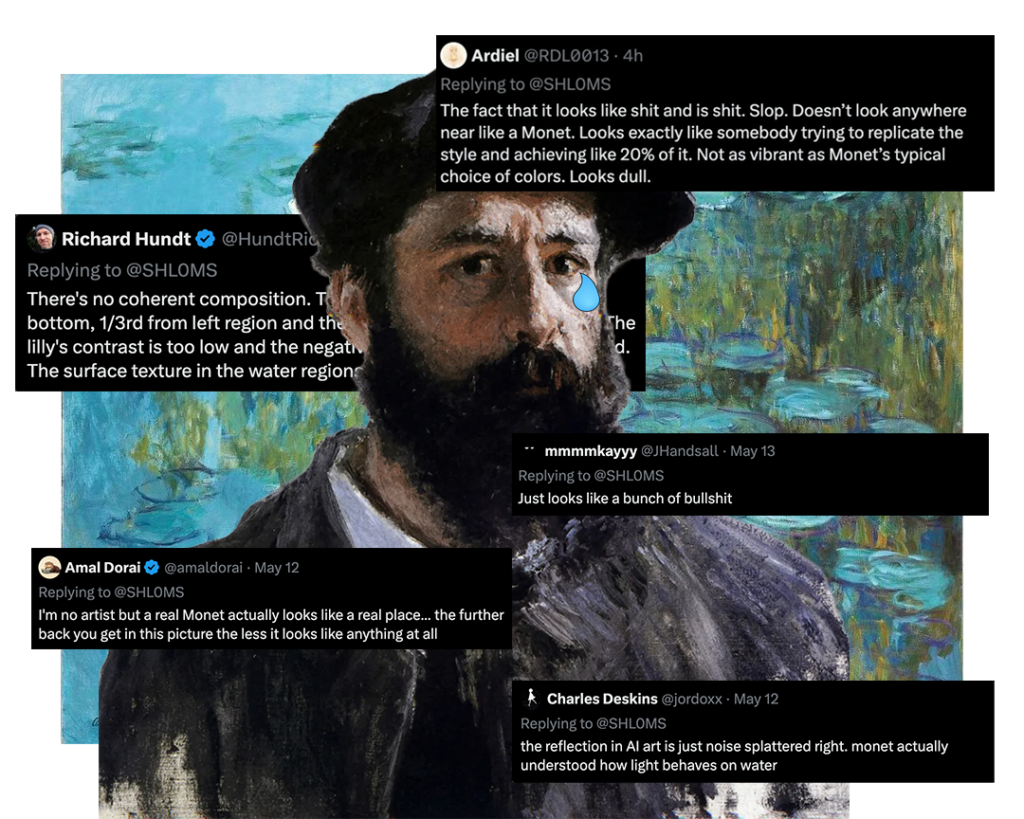
There is a necessary complication here: not every anti-AI reaction is careful, and not every critique is actually about the work. In May 2026, artist SHL0MS posted what appeared to be an AI-generated image in the style of Claude Monet and asked people to explain why it was inferior to a real Monet. The internet obliged. Commenters criticized the synthetic brushwork, weak composition, lack of depth, and absence of humanity. Then came the reveal: it was a real Monet.

Creative Bloq reported that the image was an authentic Monet from his Water Lilies series, and that the post drew more than 7 million views as people confidently identified flaws they believed proved the work was AI-generated. That does not prove AI art is good. It does not erase the labor, consent, copyright, and quality issues surrounding generative tools. But it does expose something uncomfortable: the backlash has its own shortcuts.
Slop is not only a production problem. It can also be a perception problem. The same platforms that reward AI-generated junk also reward instant certainty about AI-generated junk. A synthetic ad gets dunked on. A fake image gets dissected. A brand misuses the tool and everyone knows the correct posture by lunchtime.
Sometimes the critique is right. Often, it is right. But the Monet experiment shows how quickly taste can become reflex. The audience did not need to inspect the work because the label had already supplied the conclusion. For marketers, that is a warning in both directions. Audiences are increasingly sensitive to AI, but that sensitivity is not always nuanced. In a low-trust environment, the label becomes the experience. Taste requires attention. Slop rewards reflex.
Why This Matters for Brands
The lazy lesson is “do not use AI.” That is too simple and not especially useful. The sharper lesson is this: AI reveals whether a brand had a point of view before the prompt.
If the brand had one, AI can support research, variation, ideation, production, listening, reporting, and testing. If the brand did not, AI will happily generate a thousand pieces of content that sound like every other brand pretending to be alive online. This is why AI backlash becomes a brand equity problem. Audiences are not just evaluating whether something was made with AI. They are evaluating whether AI made the experience feel cheaper, colder, less careful, or less worth their attention.
The risk is not simply using AI. The risk is using AI where the audience expected care, craft, or human judgment, and then asking them to applaud the efficiency.
Coca-Cola’s AI holiday ad is the cleanest case study because the brand territory is emotionally loaded. Holiday advertising carries memory, ritual, nostalgia, and inherited expectations. Adweek reported that Coca-Cola’s AI-generated holiday campaign initially appeared well-received, but backlash soon followed, with critics arguing that AI stripped warmth and joy from a holiday classic.
That is the danger zone. In a low-stakes asset, audiences may tolerate AI as production support. In a beloved brand ritual, they read it differently. They do not see efficiency. They see substitution. AI becomes slop when the audience can feel the cost savings more clearly than the idea.
IAB’s 2026 research found that Gen Z consumers are much more likely than Millennials to report negative sentiment toward AI ads, with 39% feeling very or somewhat negative compared with 20% of Millennials. Its guidance is pragmatic: understand audience attitudes, use AI to enhance creative quality rather than simply cut production costs, and apply consistent disclosure practices. The industry is excited about cheaper, faster asset production. Consumers are asking whether the work got better. Those are not the same conversation.
AI-First Can Sound Like People-Last
Duolingo is the cautionary tale for brands that want to announce their AI transformation before explaining what gets better for the customer. The company’s “AI-first” shift sparked consumer backlash after CEO Luis von Ahn told employees that Duolingo would gradually stop using contractors for work AI could handle and would factor AI use into hiring and performance considerations. Customer Experience Dive reported that users threatened boycotts, and von Ahn later acknowledged that customer growth, while still strong, had been dampened by his AI commentary.
That is the problem with “AI-first” as public language. In a boardroom, it sounds decisive. To customers, employees, and creators, it can sound like a warning label. Duolingo is not a faceless enterprise tool. Its brand depends on personality, humor, pedagogy, cultural nuance, and that slightly deranged green owl whose social presence made language learning feel less like homework and more like being bullied by a mascot with excellent retention metrics. When that kind of brand says “AI-first,” people do not only hear efficiency. They hear fewer humans behind the parts of the product that made it lovable.
AI-first may be a useful internal operating principle. It is rarely a compelling consumer promise. The audience does not care whether a brand has reorganized around AI. It cares whether the product works better, the experience feels richer, and the people behind the thing still appear to care. When brands lead with the tool, audiences start looking for what disappeared.
Gen Z Is Using AI and Trusting It Less
The feed is not neutral. It rewards familiarity, speed, emotional clarity, and replicability. AI is built to produce familiar, fast, emotionally obvious, replicable material. That compatibility creates a loop: models synthesize the average, platforms distribute the recognizable, brands optimize toward what already performed, and audiences are left with more content that feels technically competent but spiritually exhausted.
That is why “AI slop” is too narrow as a category. Slop is not just an output type. It is an operating logic. It appears whenever the reason for making something is weaker than the machinery available to produce it.
Gallup’s 2026 research on Gen Z captures the contradiction well. Gen Z use of generative AI remains steady, but sentiment has moved sharply downward. Excitement dropped to 22%, hopefulness fell to 18%, anger rose to 31%, and anxiety held at 42%.
That is the story marketers need to understand. Gen Z is not rejecting AI from a distance. They are using it up close and still becoming less excited about what it represents. The public mood is not anti-technology. It is anti-carelessness.
The Backlash Is Becoming Material

There is a temptation to treat AI backlash as sentiment management: better messaging, clearer disclosure, more education, a cleaner landing page explaining responsible AI. That will not be enough. Axios reported that AI backlash is becoming an underappreciated investor risk, noting that executives are getting booed, workers are threatening strikes, and protests are frustrating data center development. The piece also cites investor concern around job loss and electric bills, plus community opposition to data centers seen as raising local electricity costs while contributing limited local economic benefit.
That last part matters because it makes AI physical. For years, platform backlash could be contained inside screens. AI changes that. The data center is a local object. It uses land. It uses power. It raises questions about utility bills, tax incentives, water, jobs, and who benefits from the boom.
When people see AI slop in their feeds, layoffs in the news, customer service getting worse, and data centers arriving in local politics, they do not experience those as separate stories. They become one story about a technology asking the public to absorb costs while promising that benefits will arrive later. The backlash is not waiting for a better explainer video. It is attached to bills, jobs, neighborhoods, creative labor, and trust.
What Marketers Should Actually Take From This
The marketing lesson is not that AI is unusable. It is that AI has to be governed by judgment, not just workflow. Brands need to stop asking, “Can we make this faster?” as if speed is a strategy. A better question is: “Will this make the audience experience better, more useful, more distinctive, or more worth trusting?”
That question matters most in high-trust spaces. Nostalgia, education, customer service, creator partnerships, cultural rituals, and emotionally loaded campaigns are not forgiving places for obvious shortcuts. When audiences expect care and get optimization, they notice.
Disclosure matters, but it will not save weak work. If saying “made with AI” makes the asset feel cheaper, the problem is probably not the label. The problem is that the work could not survive the label.
The harder question is who absorbs the cost of efficiency. Employees, creators, customers, communities, and users increasingly understand that “AI-first” can mean less labor, less care, fewer humans, weaker service, or higher local infrastructure costs. Brands do not get to frame efficiency as progress if the public experiences it as extraction.
AI can absolutely make marketing better. It can accelerate research, expand testing, improve reporting, support production, and help teams move faster. But it cannot create the judgment that keeps a brand from becoming generic. That still has to come from people who know what the brand believes, what the audience values, and when “good enough” is actually not good enough.
Final Thought
The answer is not anti-AI purity. That would be too easy, and frankly too nostalgic. Plenty of human-made content is dreadful. Plenty of AI-assisted work will be useful, beautiful, funny, efficient, or strategically sharp when guided by people with taste and a reason to make the thing in the first place.
The real question is not whether AI belongs in the creative process. It is whether the process still has judgment. AI gives marketers more power to make things. It does not give them better reasons for those things to exist. That part still has to come from somewhere: audience understanding, a distinct point of view, category tension, cultural context, creative appetite, and the willingness to say no to the passable thing.
AI becomes slop when brands use it to scale the absence of judgment.
Sources and References
- Business Insider: “Sundar Pichai has a graduation speech coming up. He’s already watching the AI backlash.”
- Reddit: “Gen Z’s AI backlash is getting louder”
- Creative Bloq: “How an AI Monet painting fooled 7M people”
- Adweek: “How Coca-Cola’s AI Holiday Ad Went From Praise To Rage”
- Adweek: “Coca-Cola Uses AI to Rekindle the Magic of Its Holiday Ads”
- IAB: “The AI Ad Gap Widens”
- Customer Experience Dive: “Duolingo went ‘AI-first’ and then came the consumer backlash”
- Business Insider: “Duolingo CEO says the company backtracked on plans to evaluate employees based on AI use”
- Gallup: “Gen Z AI Adoption Steady, but Skepticism Climbs”
- Axios: “How AI backlash could cost investors”
- Business Insider: “Cerebras CEO says AI companies have done a terrible job selling data centers to communities”
- Axios: “Tech giants back new data center climate initiative”