Three months of maternity leave, several loose gemstones, one extremely famous raccoon, and proof that apparently my brain does not know how to take PTO.
A look at the cultural moments I couldn’t stop tracking while I was technically supposed to be offline.
I took three months off this summer for maternity leave, and for the most part, I actually took them off. I was not checking dashboards, thinking about Engagement rates, or pretending that opening Slack from my phone somehow did not count as working.
There is, however, apparently a limit to how far you can remove a social strategist from social media before her brain starts quietly collecting evidence anyway. Because while I was technically off, I kept noticing things, filing them away somewhere between newborn feedings and whatever bizarre corner of TikTok the algorithm had decided I belonged in that day.
They were not necessarily the biggest stories of the summer, and they were not always the most important ones. They were the things that made me think, Wait. Why is everyone suddenly doing this? Why do I know this much about it? How did the internet convince thousands, or millions, of other people to care too? And maybe most importantly, who else is up at 4 am I can text about this?!
Some were commerce trends. Some were fandom stories. One involved a parasite. One involved a Vikings. Several involved me making questionable decisions in the middle of the night.
What connects them is not that they all belong in the same neat trend report. They absolutely do not, and I will not be putting Cyclospora and My Chemical Romance into a quadrant for anyone.
What they do show is how quickly social can change what something is. A product becomes entertainment, an old song becomes current inventory, a concert becomes an evolving fictional universe, and a raccoon becomes a collectible asset.
So, before I fully return to regularly scheduled programming, these are the things I could not stop tracking during three months away. Unfortunately for everyone else, I have a lot of thoughts.
Editor’s note: This article is a long one, as most are when you have months to write it. While I think every word is worth reading, you may not have time for that. Use the links below to travel around at your leisure.
Table of Contents
- TikTok Diamond Auctions
- Pearls
- Lindsay Clancy
- Cyclospora
- The World Cup
- 2016 Revival Take 2
- Viking Hip Hop
- My Chemical Romance
- Jimothy
- What These Trends Actually Change for Marketers
- Final Thought
TikTok Turned Loose Diamonds Into Appointment Television
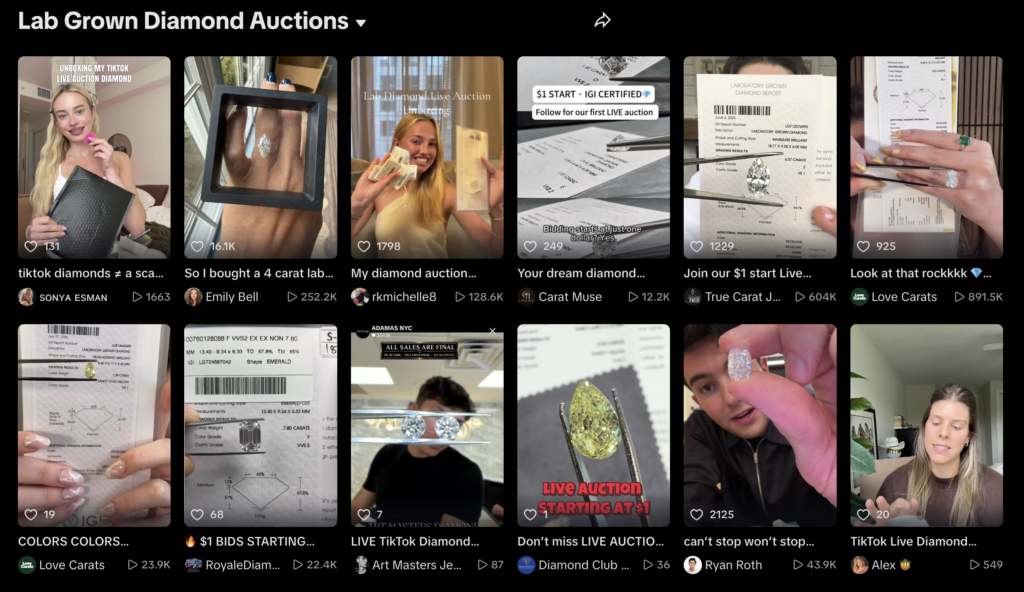
At some point this summer, TikTok decided that what everyone really needed was QVC for loose lab-grown diamonds. Against all reasonable expectations, this worked exceptionally well on me.
I know this because I bought some. Multiple, actually, which is not a sentence I expected to write before maternity leave.
There is a very specific kind of decision-making that happens around 3 a.m. when you are feeding a baby and someone on TikTok is holding a gemstone under fluorescent lights while yelling that the chat is letting it go for way too low. Under those conditions, purchasing a loose diamond with absolutely no plan for setting it starts to feel less like impulse shopping and more like a competitive sport.
I am now the proud owner of several diamonds and gemstones, and someone recently asked me what I planned to do with them. I had nothing because possession was apparently the entire strategic objective. It was for the love of the game.
And I am not particularly unusual here. TikTok’s lab-grown diamond auctions have built an entire viewing culture around people who are not necessarily arriving with a jewelry purchase already in mind.
The auctions can move incredibly fast, sometimes lasting only 10 or 15 seconds. Many start bidding at $1, with loose stones frequently selling around $100 to $200 per carat while auctioneers yell variations of “go, go, go” and inform everyone that, tragically, the chat is once again bidding far too low.
The pricing is part of the hook. Rings.com’s August 2026 index put the median listed price of a one-carat lab-grown diamond at $555 across six U.S. retailers, with significant variation even among similarly graded stones, so watching a stone close at a fraction of traditional retail pricing can feel less like jewelry shopping and more like someone just discovered a pricing glitch.
Then the behavior starts getting more interesting than the stones themselves. One woman interviewed by The Guardian had bought more than 30 diamonds after discovering the auctions in June, while another viewer said her family sometimes projects the livestream onto a larger screen at home.
One repeat viewer described telling her husband, “my show is on” before settling in to watch. At that point, the audience has already told you what category this belongs in.
It became programming. People are not only opening TikTok because they need an oval diamond; they want to know what comes up next, what it sells for, whether someone got a bargain, and whether the chat completely loses its mind over a giant pear shape.
The auction has plot, recurring characters, stakes, scarcity, winners, and losers. It also has a host narrating the entire thing with an emotional intensity usually reserved for the final possession of an NBA playoff game.
Traditional e-commerce spends enormous amounts of time trying to remove friction from the shopping experience. Find the product, compare the options, check out quickly, and leave. Social commerce can run on the exact opposite logic because the friction itself is entertaining. The waiting matters, the bidding matters and the possibility that the next stone might be larger, stranger or cheaper matters.
One jeweler described the appeal as the “rush” of getting a diamond for a couple hundred dollars. That rush is part of the product before the diamond ever arrives.
That is a useful distinction for brands looking at livestream commerce. Attaching a host to a product page does not automatically create entertainment, just like turning on a camera does not automatically create a show.
You need a format people would watch even if they were not planning to buy. That is also, apparently, how you wind up with a drawer full of gemstones at your house and no jeweler on speed dial.
We all have our crosses to bear. Mine happen to have certificates.
Editor’s note: Lab-grown diamond pricing moves quickly. Rings.com’s August 2026 index listed the median price of a one-carat lab-grown diamond at $555; by September, that figure had fallen to $510. I’m using the August figure here because it reflects the market during the period I was actually watching, and clearly successfully participating in, these auctions.
Pearl Livestreams Took the Same Commerce Model and Made It a Reveal Game
Fun fact about me: during COVID, I took a class to become certified in pearls. Yes, it’s real. No, I don’t know why I did it. And yes, this is probably the only place I can flex that.
Sidebar, since apparently this certification is finally earning its keep: did you know you can do a quick real-versus-fake pearl check by gently rubbing one against your teeth? No, really. Fake pearls are smooth and slide right off, while real pearls have a faint, gritty texture that feels a little like very fine sand against your enamel. This is not a substitute for sending your jewelry to a gem lab, obviously, but it is an extremely useful piece of party trivia. Thank me later.
So yeah, diamonds were not even my only jewelry livestream problem this summer. Apparently, maternity leave also gave me enough unsupervised screen time to become familiar with the mechanics of blind pearl jewelry auctions and scoops.
The timing is particularly good because pearls are already having a broader fashion reset. ELLE declared that fashion had reached “peak pearl” this summer, pointing to oversized, stacked, and aggressively reworked versions appearing across brands including Vaquera, Simone Rocha, Valentino, and Chanel.
Pearls have moved a considerable distance from the polite strand sitting in your grandmother’s jewelry box. TikTok looked at that perfectly healthy fashion trend and decided it also needed clams.
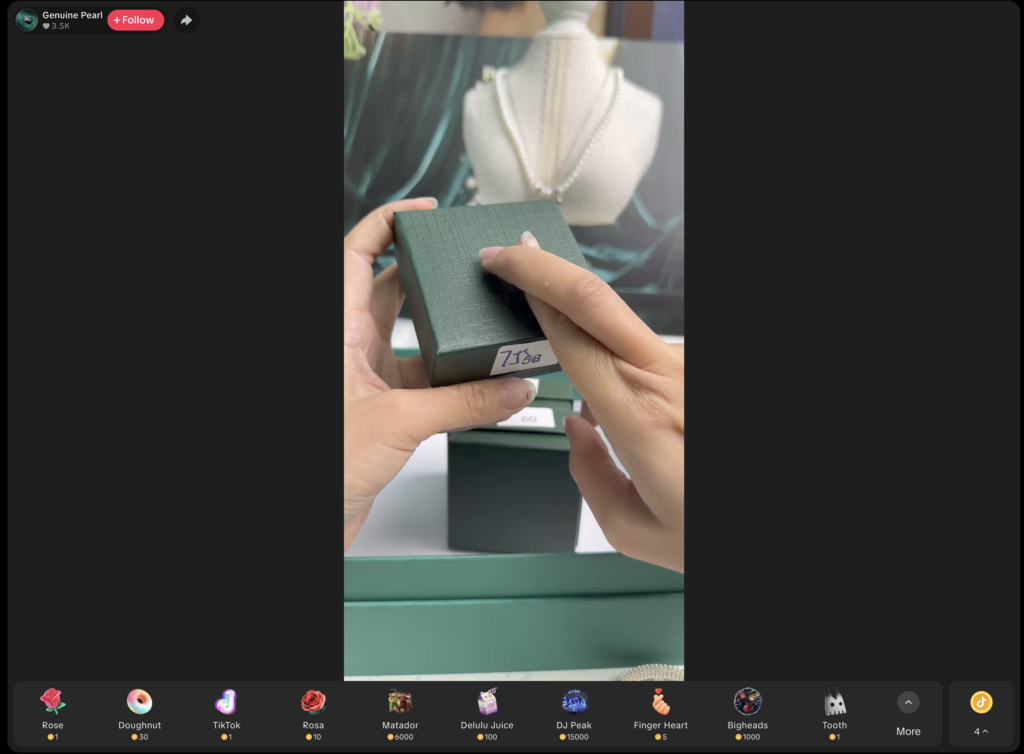
Pearlism, one of the sellers I kept encountering, has effectively turned its TikTok Shop into a series of host-driven live experiences. Individual listings are organized around named live hosts, with several live-customization products showing roughly 1,500 to 2,100 sales each, while pearl scoop products promise 20 or more pearls per scoop and other listings are explicitly sold to be “opened in live.”
That host structure is not incidental. The person facilitating the purchase has become part of the product experience, which means you are not simply buying a pearl. You are buying your reveal with this host.
You can buy scoops. You can buy pearls that are revealed on camera. You can watch colors and shapes appear in real time and decide what you want to turn them into while everyone else watches your order because, apparently, voyeuristic jewelry procurement is now a content vertical.
I say that with affection because, once again, I was there. At this point, I cannot pretend I was conducting research.
Where the diamond auctions operate on competition, pearl livestreams operate on anticipation. What did the scoop get? What is inside? Is that weird-shaped pearl actually the best one? What color is the Edison? What should it become?
The transaction creates an information gap, and the content closes it. That same psychology powers blind boxes, collectible card breaks, mystery bags, unboxings, and a surprisingly large portion of children’s YouTube.
Humans really enjoy not knowing what is in the thing until someone opens the thing. Like Schrodinger’s pearl. Social commerce is simply getting better at monetizing that gap.
That is also where pearls diverge from diamonds strategically. Diamonds turn buying into spectator sport, while pearls turn buying into an episodic reveal.
Both models give audiences something traditional e-commerce cannot: a reason to stay after they understand what the product is. The product gets you in the room, but suspense keeps you there.
For marketers, that should change the question around livestream commerce. “How do we demonstrate our product live?” is probably not interesting enough, because demonstration alone gives the audience very little reason not to scroll.
The better question is what information, tension, or transformation can remain unresolved long enough that someone wants to keep watching. Attention before transaction is increasingly the infrastructure of social commerce, and the necklace comes later.
The Lindsay Clancy Trial Showed What Happens When Platform Behavior Collides With an Institution That Was Never Built for It
Trigger warning – while I don’t go into any of the gritty details nor show any real imagery that could remind you of them, this is a dark topic. If you have a hard time with stories like these, click here to travel to the next one. No judgment.
I remember when the Lindsay Clancy case first happened. I was pregnant with my first child at the time, so the circumstances hit close enough to be deeply upsetting, and then, like most enormous news stories eventually do, it moved out of my daily attention.
This summer, right after I had my second child, it came roaring back into my feed. Maternity leave is particularly conducive to this kind of algorithmic capture because you are awake at bizarre hours, your schedule has dissolved completely, and your phone suddenly has a lot more opportunities to decide what your personality will be for the next four hours.
My algorithm chose a homicide trial involving postpartum psychosis. Subtle.
By August, more than 164,400 TikTok videos had been posted using #clancy. Social users were analyzing testimony, psychiatric evidence, witnesses and courtroom behavior in real time, while creators developed ongoing audiences specifically around covering the proceeding.

One creator told The Boston Globe her Clancy videos were regularly generating more than 100,000 views, while 14,000 to 25,000 people were watching her live coverage during court days. The trial had effectively acquired daytime programming numbers, only the stakes were very obviously not fictional.
Then the internet discovered defense attorney Kevin Reddington. Reddington is 75, has practiced law in Massachusetts since 1975, and somehow spent part of August becoming a social character called “Big Redd,” then “Shreddington.”
By September 1, more than 16,500 TikToks had been posted using #kevinreddington, including compilations of his “best moments,” while commenters discussed his accent, courtroom demeanor and various personality details. The fascination got granular enough that Reddington was asked what kind of burgers he likes, what candies were sitting on the defense table and where he had printed his courtroom posters.
For anyone wondering, the answers were plain, cinnamon Altoids and Staples. This is apparently information thousands of us needed.
But social influence did not stay inside the phone. More than 400 supporters dressed in pink gathered outside Plymouth Superior Court on August 20 after a 1 a.m. TikTok call to gather, and the organizer said related demonstrations had expanded into more than 18 states and several other countries.
A TikTok creator discussing the psychiatric facility involved in the case was identified by the defense and became a potential witness before ultimately being denied permission to testify. Separately, a GoFundMe started by a TikTok creator for Clancy’s parents passed $1 million from nearly 31,000 donations.
There was also an uglier layer to all of this, because both sides of the social conversation got aggressive fast. I saw people posting videos in support of Clancy while pretending to hurt baby dolls, others arguing that women should essentially be locked up after giving birth until they could prove they did not have postpartum depression, and an endless supply of people using postpartum depression and postpartum psychosis as though they were interchangeable diagnoses.
They are not. PPD is relatively common and does not inherently involve losing touch with reality, while postpartum psychosis is rare, severe, and can involve delusions, hallucinations, and other symptoms of psychosis. See here for more info.
The trial became a magnet for self-appointed “experts” who seemed to materialize whenever one side of the argument needed reinforcement, along with amateur sleuths confidently advancing theories ranging from shaky to completely unsupported. Total madness, and not particularly useful madness either, because underneath all of it was a conversation about maternal mental health that desperately needed more precision, not thousands of people becoming board-certified psychiatrists between TikTok scrolls.
Then there was Emily Thorndike, which might be the cleanest example of the social-media version of the trial colliding with the actual one. Thorndike, a licensed clinical social worker and former McLean Hospital employee, had been posting on TikTok criticizing testimony about the facility where Clancy had been treated, arguing that what viewers were hearing in court did not match her own experience working there.
Reddington found her through those videos and moved to call her as a defense witness. From the perspective of TikTok, it felt almost inevitable: someone online spots what looks like a hole in the official story, the attorney notices her, and suddenly the creator is headed to court. The true crime girly dream came to fruition.
Except that the TikTok story did not translate particularly well once it entered an actual courtroom. Thorndike had left McLean about a year before Clancy was admitted, acknowledged that she had been following the trial livestream before being sequestered, and ultimately testified only in a hearing outside the jury’s presence while the judge decided whether she had anything sufficiently relevant to offer.
The judge concluded that her testimony had limited relevance and did not allow the defense to put her before the jury. The TikTok narrative had made it all the way to the courthouse, only to essentially bomb its courtroom audition.
Then came the moment that escaped the courtroom entirely. Asked where she lived, Thorndike replied, “I actually live in Brooklyn, New York, but I summer on Cape Cod. I’m spoiled like that,” and that clip promptly developed its own social life.
TikTok users dragged the comment, questioned her credibility, and turned a few seconds of awkward testimony into another mini-news cycle. Thorndike later posted apologies, explaining that she had been nervous and unprepared; one of the apologies disappeared, and her account eventually went private. On a personal note, I actually felt bad for her. It was clear she was nervous and in over her head. We all want to think we would be a shining light in moments like that but if you sweat when asked why you were late to brunch by a close friend, being a witness in court may not be your deeper calling.
That sequence is almost too perfect for this entire story. The creator entered the case because TikTok had made her look like someone with information the courtroom needed, but the legal system judged her actual relevance to be limited. Then, once that role fizzled, social immediately found an entirely different reason to keep her in the narrative.
The “I’m spoiled like that” clip became more culturally durable than anything she might have contributed as a witness. Social authority and institutional authority, it turns out, are very different things.
And somehow Thorndike was not even the only side character to get her own spinoff.
On August 24, a Court TV camera panned across the shoulder to shoulder courtroom gallery and briefly landed on freelance journalist Brittany Romano wearing a green dress, sitting in the front row. Romano looked at the camera, smiled, laughed, and winked, and within hours she had been transformed into “Green Dress Girl,” because apparently this triple-murder trial still had room in the content calendar for another recurring character.
Romano was there wearing Vanity Fair credentials and had been discussing a possible personal essay about growing up near Clancy in Connecticut. After the clip went viral, Vanity Fair said it would no longer move forward with the essay and informed the court that Romano was no longer credentialed by the magazine, citing conflicts with its editorial standards and processes. Romano pushed back on the framing, noting that she was a freelancer, had no employment relationship with the publication and therefore had not literally been “fired.”
That clarification did absolutely nothing to slow the internet down. Romano was caught in a parking lot interview explaining that she had grown up with Clancy and that her father had previously texted her about looking miserable on the Court TV feed, which was why she had smiled for the camera. The explanation then became its own content, followed by Instagram statements, more media coverage and Romano saying she was receiving horrific threats over the clip.
So within a matter of hours, a woman sitting in the gallery became a viral nickname, a professional controversy, a series of interviews and another object for both sides of the internet to dissect. Her actual role in the case was peripheral, but that almost did not matter because social media had already promoted her into the cast.
That might be the strangest part of the Clancy trial as a media event. The courtroom kept producing people whose legal importance and social importance had almost nothing to do with each other, and the feed was extremely good at confusing the two.
A criminologist interviewed by CT Insider described social media as “bellows on a fire” for cases like this. The platforms did not create the underlying public interest, but they gave it machinery.
That machinery is very familiar to anyone who studies fandom. Social trains people to identify protagonists, antagonists and supporting characters, while rewarding recurring jokes, instantly recognizable personality traits, serialized updates and collaborative theories.
Those behaviors are benign when everyone is decoding Taylor Swift Easter eggs. They become significantly more complicated when the source material is a homicide trial.
The courtroom comes with rules about evidence, procedure and legal consequence. The feed comes with incentives around personality, emotional certainty, repetition and content velocity.
The algorithm does not fundamentally understand the difference between a fictional courtroom drama and an actual courtroom. People do, but the behavioral mechanics around consuming both can start looking uncomfortably similar.
The difference is that real cases have real consequences, and Patrick Clancy’s lawyers have made that abundantly clear. As conspiracy theories about his alleged involvement in the murders spread across social, his legal team began sending cease-and-desist letters to creators large and small. Some of those creators had built significant audiences by pushing the story, only to go suddenly quiet once the content stopped being an abstract engagement engine and an envelope showed up at their actual house. It is one thing to speculate for views. It is another when the subject of that speculation has counsel.
That makes this more than a true-crime story. For social intelligence teams, it is an example of what happens when institutional information enters an ecosystem where audiences have been trained to remix everything.
Conversation volume can tell you the case is receiving enormous attention. It cannot, by itself, tell you what social has turned the case into, and that second question is where the real cultural analysis starts.
Editor’s Note: This was written before Patrick Clancy’s now-infamous 60 Minutes interview. That interview absolutely belongs here, but the global reaction to it is substantial enough that it deserves its own analysis rather than getting tacked onto this one as an afterthought.
Keep an eye on LFPoolParty after the dust settles, and we will circle back.
Cyclospora Made Separate Food Safety Stories Feel Like One Enormous Recall
I love salad more than the average person probably does. So the summer of SALAD felt specifically engineered to irritate me.
For a while, opening social media felt like playing produce roulette. Lettuce was suspicious, blueberries were questionable, and sprouts appeared to have personally declared war.
The Cyclospora outbreak alone was enormous. By September 11, the FDA reported 12,883 illnesses across 21 states, 570 hospitalizations and two deaths connected to an outbreak associated with processed iceberg lettuce sourced from central Mexico and recalled by Taylor Farms de Mexico.
Early cases included people who had eaten at Taco Bell, and ingredient-level analysis found that 90% of interviewed Taco Bell cases reported eating iceberg lettuce. Taylor Farms ultimately removed all iceberg lettuce sourced from central Mexico from the U.S. market, with recalled products distributed widely through foodservice and select Walmart locations.
That would have been plenty of food anxiety for one summer. Instead, other investigations kept landing.
An E. coli outbreak linked to organic frozen blueberries had reached 17 reported illnesses and six hospitalizations by September, with recalled products distributed through Walmart and Publix across dozens of states and Puerto Rico. A separate investigation tied to alfalfa sprouts involved 55 illnesses across 15 states, including cases involving multiple E. coli strains and Salmonella.
These were different outbreaks with different pathogens, products, companies and timelines. Social media compressed them into one piece of information anyway: Why is all the food being recalled?
Scientifically, that is probably not the right conclusion. Culturally, it is exactly what happens.
Most people do not maintain a spreadsheet documenting whether the lettuce was Cyclospora, the berries were E. coli O145, or the sprouts had multiple strains of E. coli plus Salmonella. They remember seeing five posts about contaminated food while standing in the grocery store, and suddenly regarding the produce section with suspicion.
That distinction matters because perception forms cumulatively. Regulators investigate events individually, brands manage incidents individually, and news organizations publish stories individually.
The audience experiences a feed. The feed collapses adjacency into narrative.
One recall is a recall, but five recall posts in two weeks can become something is wrong with the food supply even when those incidents are not related. The perceived pattern can become culturally stronger than the distinctions between the underlying events.
That is where social intelligence becomes more useful than simple issue monitoring. The question is not only whether people saw your specific announcement, but what else they saw immediately before and after it and what larger story those pieces formed once they were mentally stacked together.
Context is not background on social. Context is part of the message.
As someone who would happily eat a salad large enough to require its own ZIP code, I found this personally inconvenient information to learn during the summer. I would like produce to become boring again (#MPBA).
The World Cup Was Not One Cultural Moment. It Was an Operating System for Thousands of Them.
The World Cup Was a Social Event Before It Was a Sports Event
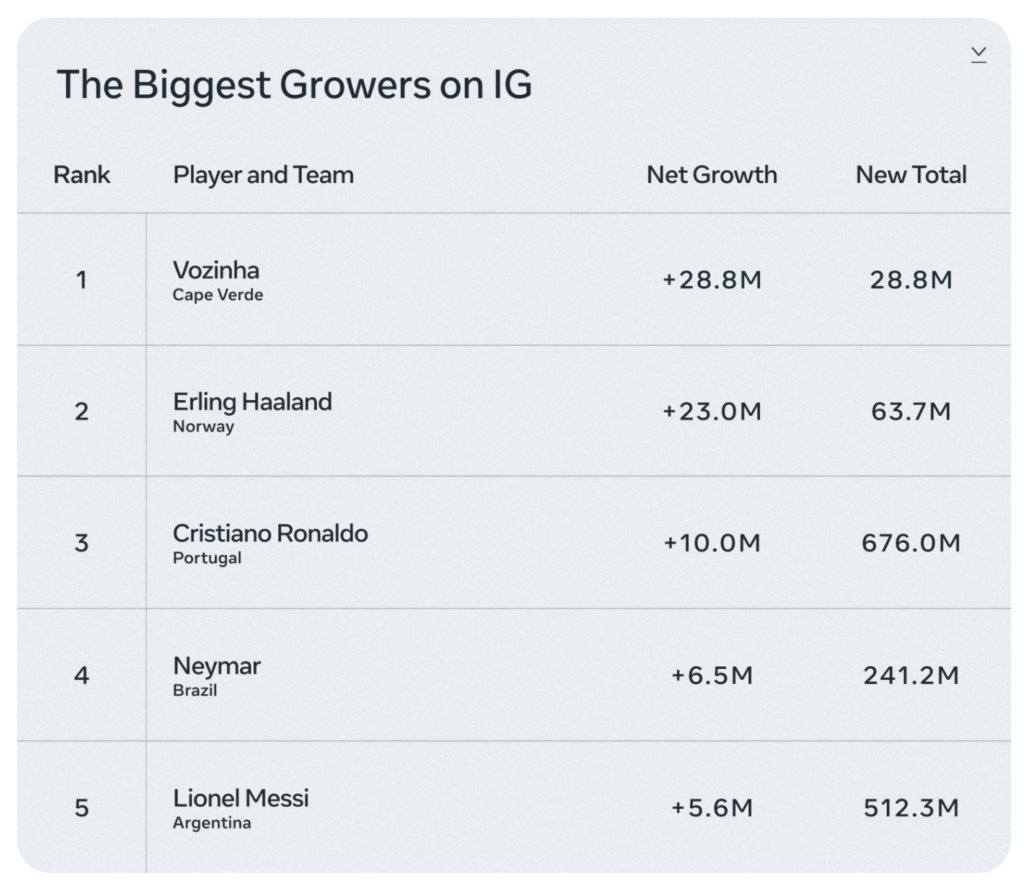
The 2026 World Cup was obviously massive on social, but the scale still feels a little absurd when you actually look at the numbers. TikTok reported more than 1.2 trillion views on World Cup content, more than 22 million hashtagged videos, nearly 520 million visits to its tournament hub and more than 660 million unique views of broadcaster livestreams. Its digital Panini activation alone drew tens of millions of participants, which is a useful reminder that people were not just watching the tournament. They were collecting, posting, remixing, predicting and building rituals around it.
Meta saw the same thing from a different angle. WhatsApp reportedly handled more than 30 million messages per second during the final, while players collectively added hundreds of millions of followers during the tournament. The World Cup was not simply a broadcast event with social commentary happening around the edges. Social became part of the infrastructure of how the tournament was experienced.
And then there was ranch dressing.
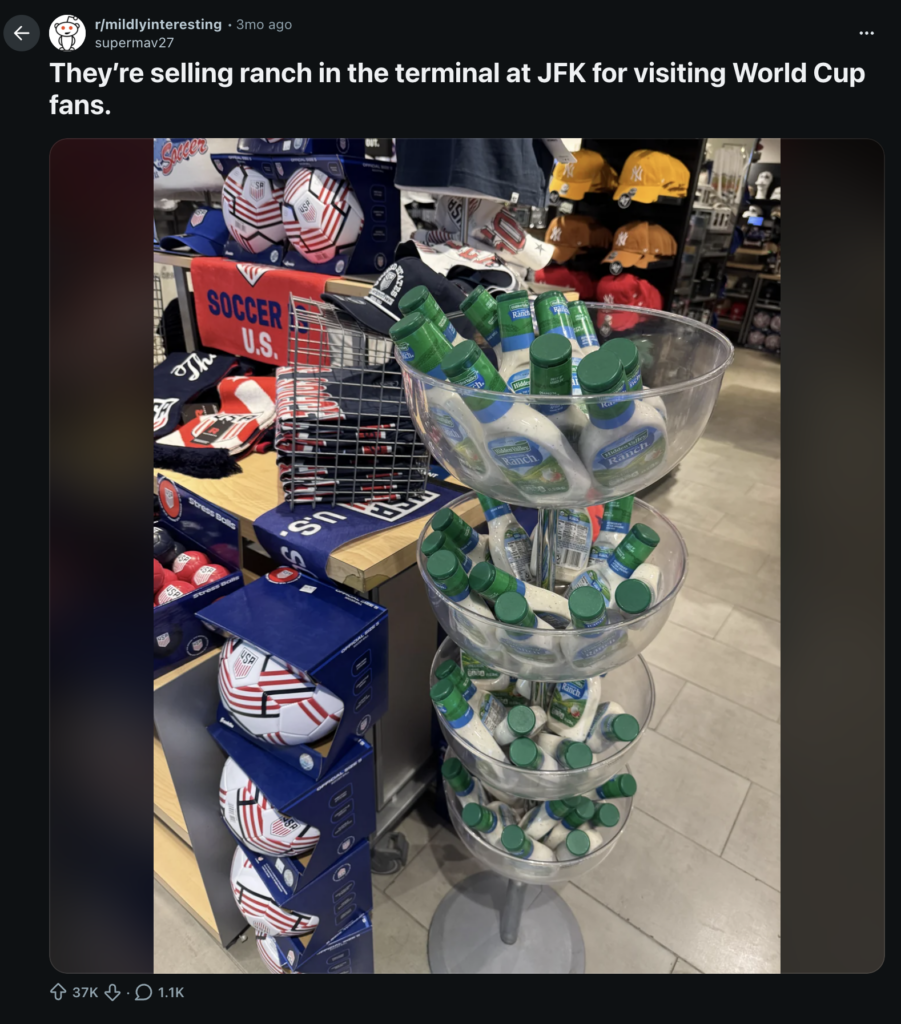
International visitors were documenting their experience of America itself, which is how ranch somehow became one of the tournament’s breakout supporting characters. European fans started posting about discovering ranch with the kind of evangelical enthusiasm Americans usually reserve for explaining why their regional gas station is actually a lifestyle destination. One Swedish fan went viral with “EUROPE WE NEED RANCH ASAP,” and the trend got big enough that the TSA eventually had to remind departing fans that ranch is, in fact, a liquid and cannot simply be smuggled home by the bottle in a carry-on. Brands immediately followed the audience signal, with Kraft and Hidden Valley turning the accidental cultural moment into travel-friendly ranch products and activations.
That is what made the World Cup such an interesting social event. The matches created the audience, but the internet decided what else became part of the tournament’s mythology. Sometimes that was a player, a goal, or a celebration. Sometimes it was the revelation that Americans have apparently been hoarding a white condiment from Europe for decades.
For marketers, the lesson is not that every global sporting event needs a ranch strategy. It is that the largest cultural moments rarely stay contained inside the category that created them. Once enough people are watching the same thing at the same time, they start generating adjacent stories, rituals, jokes, products, and obsessions that can become culturally significant on their own.
The opportunity lies in recognizing which of those side stories have actually earned the audience’s permission before a brand barges in and tries to make itself part of the joke. The World Cup showed how quickly a sporting event can become a platform for travel content, food discovery, national identity, player fandom, memes and completely accidental condiment diplomacy.
Apparently, 2026 Is 2016 Again, Except Now the Algorithm Controls Catalog Distribution
We already talked about this earlier this year in Quick Dip: 2016 Core, when social collectively decided that 2026 should apparently become the new 2016. Snapchat filters, chokers, bottle flips, grainy photography, Fifth Harmony posters, and other artifacts came roaring back with the selective memory only nostalgia can provide.
Our argument then was that nostalgia does not recreate history particularly accurately. It rebuilds the best-feeling version.
The original 2016 was messy. The 2026 version is the remaster.
What changed this summer is that the nostalgia stopped being primarily aesthetic and started showing measurable distribution power. Katy Perry’s “The One That Got Away,” first released as a single in 2011, became TikTok’s No. 1 Global Song of the Summer for 2026.
According to TikTok, the track soundtracked more than 42 million videos generating more than 55 billion views. It also returned to charts around the world, including a 21-week run on the Billboard Global 200.
Mac Miller’s 2016 track “Cinderella” became TikTok’s No. 2 U.S. Song of the Summer. Lenny Kravitz’s 1991 “It Ain’t Over ‘Til It’s Over” landed at No. 3 after being introduced to another cultural context through FX’s Love Story: John F. Kennedy Jr. and Carolyn Bessette.
That is not nostalgia functioning as decoration. It is nostalgia functioning as a distribution system.
Katy Perry put the strange temporality of it fairly well herself when she said, “you never really know where a song is going to end up.” Social has taken that idea and turned it into an actual business reality.
A song no longer has one cultural lifecycle. It can release, chart, finish its promotional run, move into catalog, sit quietly for 10 or 15 years and then become culturally current again because millions of people suddenly discover a new use for it.
And that new use does not need to resemble the old one. A lyric can become a relationship-edit format, a chorus can become the soundtrack to a television fandom or a song can start carrying the emotional weight of an era it was only loosely associated with the first time.
The audience effectively builds the second campaign. Entertainment companies may own the catalog, but social users increasingly decide when a particular piece of it becomes active again.
That makes the archive considerably more valuable and considerably less predictable. Catalog is not dead inventory; it is dormant inventory waiting for the right cultural use case.
That requires listening strategies that look backward as well as forward. If you are only monitoring conversation around the thing you released this week, you may miss audiences quietly turning something from 2011 into one of the biggest pieces of music on the platform.
Our original 2016 Core piece argued that nostalgia works because it reconstructs emotional texture more than factual history. The current music data adds another layer, because once social reconstructs that emotional texture, it can redirect attention, streams, and chart performance along with it.
The archive is no longer where culture goes when it is finished. Sometimes it is where culture waits until TikTok needs it again.
Ravenforge Is What Happens When AI Builds the Band Backwards
At some point during maternity leave, my algorithm decided I needed Viking music. Not traditional Nordic folk, not Viking metal, but enormous cinematic songs populated by tattooed Norse warriors, ethereal women, ravens, fire, suspiciously perfect cheekbones, and enough bass to make Valhalla sound like it recently installed a subwoofer.
The project I kept getting served is Ravenforge, and calling it a “band” is already where things get complicated. Ravenforge exists on Spotify, Apple Music, and Amazon like any other artist, with albums, singles, recurring imagery, and a rapidly expanding catalog, but there is no traditional public-facing lineup or touring band attached to the identity. Its 2026 releases include Runes in the Storm, Crown of Storms and, by September, Iron Sky.
Then there are the characters orbiting it, which makes the whole thing even stranger. Draugr Balled, the Viking rapper I initially thought was Ravenforge, is actually credited as his own artist with his own sprawling catalog and artist pages. He also appears alongside Ravenforge, Ragal Ironbull, and Draugr Beatz on releases like “Runes in the Storm,” which makes this look less like a conventional band and more like an interconnected universe of digital Viking personas collaborating with one another.
That distinction somehow makes the concept better. We have apparently reached the point where I need a conspiracy board diagram to understand the personnel structure of an AI Viking music scene.
The music itself is built from a very recognizable set of ingredients. There are war drums, chants, mythology, enormous choruses, heavy modern production, and lyrics about Odin, shield walls, storms, wolves, and whatever else you would expect someone to yell immediately before charging into battle. Ravenforge’s own catalog includes titles like “Until Valhalla Calls,” “Blood Moon Chant,” “Ashes of Odin,” “Wolf Blood,” “War Drums of Midgard” and “The Shieldwall Stands,” so subtlety has not been invited to the longhouse.
The release velocity is where I started paying closer attention. Runes in the Storm arrived June 24 with 10 tracks, Crown of Storms followed on July 20 with 15 more, and Iron Sky showed up September 14 with another 12. That is 37 album tracks across three releases in less than three months, before even getting into singles and collaborations.
A human band operating at that pace would require several clones, an IV drip and eventually a very serious conversation about labor law. An AI-native music operation can treat the album less like a major artistic event and more like another publishing unit.
And the visual side makes what is happening pretty difficult to miss, at least if you spend enough time online. Ravenforge’s social content uses recurring hyper-polished Viking characters that move, perform and lip-sync with all the familiar tells of generative video, including tiny facial inconsistencies and mouths that occasionally seem to have received different choreography than the song.
The female vocalist is my favorite giveaway because sometimes she appears to have too many teeth, and when she sings they sort of blend together into one unsettling wall of AI dentistry. In other clips, the mouth is making one sound while the vocal is very clearly making another, which apparently has not stopped a portion of the comments from interacting with these characters like they are actual musicians.
That is where the disclosure question gets interesting. Ravenforge does not exactly interrupt the TikTok experience with HELLO, NONE OF THESE VIKINGS HAVE SOCIAL SECURITY NUMBERS, even though the synthetic nature of the visuals feels extremely obvious if you are accustomed to spotting AI content.
The qualifier is important because “obvious” is increasingly generational. If you live online and have spent the last few years watching generative video improve month by month, your brain catches the tells almost instantly. If your primary social-media habitat is a slightly different corner of the internet, apparently a Viking woman with 46 teeth and an alphabetically confused mouth can still clear the realism threshold.
The platform context helps sell the illusion. Ravenforge appears in the same Spotify interface as human musicians, the songs sit in the same streaming ecosystem, and related identities like Draugr Balled have their own artist pages, social accounts and catalogs. Draugr Balled’s official Linktree even describes him simply as an “Epic Viking hip-hop artist,” sending users directly to Spotify, Apple Music, TikTok and YouTube with all the familiar architecture of a conventional musician.
The result is not exactly deception in the traditional sense, but it is ambiguity doing useful work. Nobody needs to explicitly announce that two Viking musicians met in a rehearsal space and started a band if every platform signal surrounding them already tells the audience, this is an artist.
And by the time someone decides to investigate, the audience behavior has already happened. They heard the track, watched the video, saved it, played another song and gave Spotify or TikTok one more signal that apparently what this person really needs is another extremely tattooed Norseman appearing over the horizon.
That is what makes Ravenforge more interesting to me than the endless debate over whether AI music is “real art.” The more immediate question is what happens when music starts operating with the production economics and publishing cadence of social content.
Traditional bands have bottlenecks. People have to write songs, rehearse them, record them, create visuals, coordinate releases, play shows, occasionally sleep and, if rock history has taught us anything, eventually become furious with the drummer.
An AI-native project can behave very differently. Once a recognizable package works, Norse mythology, cinematic production, recurring characters, massive choruses, ravens, repeat, the system can keep generating variations on that identity far faster than a traditional act could realistically sustain.
That makes Ravenforge feel less like a band that happens to use social media and more like a content franchise where music is the primary format. The albums, fictional performers, collaborations, artwork and videos all reinforce the same universe, while separate identities like Draugr Balled can release their own music and then reappear as collaborators inside it.
In other words, AI has not just generated some songs. It is starting to generate the social architecture of a music scene.
Ravenforge already has releases, recognizable visual codes, recurring themes, affiliated artists and a catalog deep enough to make the project feel established despite the fact that its visible 2026 discography appeared at extraordinary speed. Those are signals human artists traditionally accumulate over years while audiences watch an identity slowly take shape.
What it does not have, at least yet, is the institutional weight that normally makes music fandom durable. There are no concerts people remember attending, no disastrous interviews that become lore, no legendary early shows, no lineup changes, and no public breakup where everyone unfollows everyone else on Instagram.
The synthetic system can create abundance almost instantly, but abundance and history are not the same thing. I do, however, look forward to the day an AI band has a complete emotional breakdown and feuds through IG Stories like the good lord intended.
For marketers, that distinction matters. AI is not simply making individual assets faster or cheaper anymore; it is making it possible to build whole fictional identities, populate them with recurring characters, surround them with related properties, and iterate the entire system based on whatever audience signals perform.
Ravenforge did not need ten years of playing dive bars for five people before an algorithm could figure out who might like it. It needed recognizable signals, repeatable output, and enough actual humans willing to keep listening.
Apparently, Valhalla has discovered content optimization and is extremely excited to sell you a hoodie.
Editor’s note: If you are the mastermind behind Draugr Balled, Ravenforge, or any of the other 100 viking music bands that have taken over my FYP, I would love to talk to you! Hit me up, my guy.
My Chemical Romance Took Nostalgia and Gave Fans Homework
I need to disclose a conflict of interest before we proceed. My Chemical Romance is my favorite band, and my second daughter is literally named after one of their songs, so journalistic detachment has left the building.

S/C/A/R/E/C/R/O/W Na Na Na Varga
I am, however, capable of recognizing excellent fandom strategy while emotionally compromised. These things can coexist.
MCR could have spent this entire cycle living comfortably inside nostalgia. The Black Parade turns 20 this year, the band is playing stadiums, and elder emos are emerging from suburban homes across America, putting eyeliner back on and conducting involuntary research into how much standing their lower backs can still tolerate.
That alone would have sold tickets. Instead, the band built Draag.
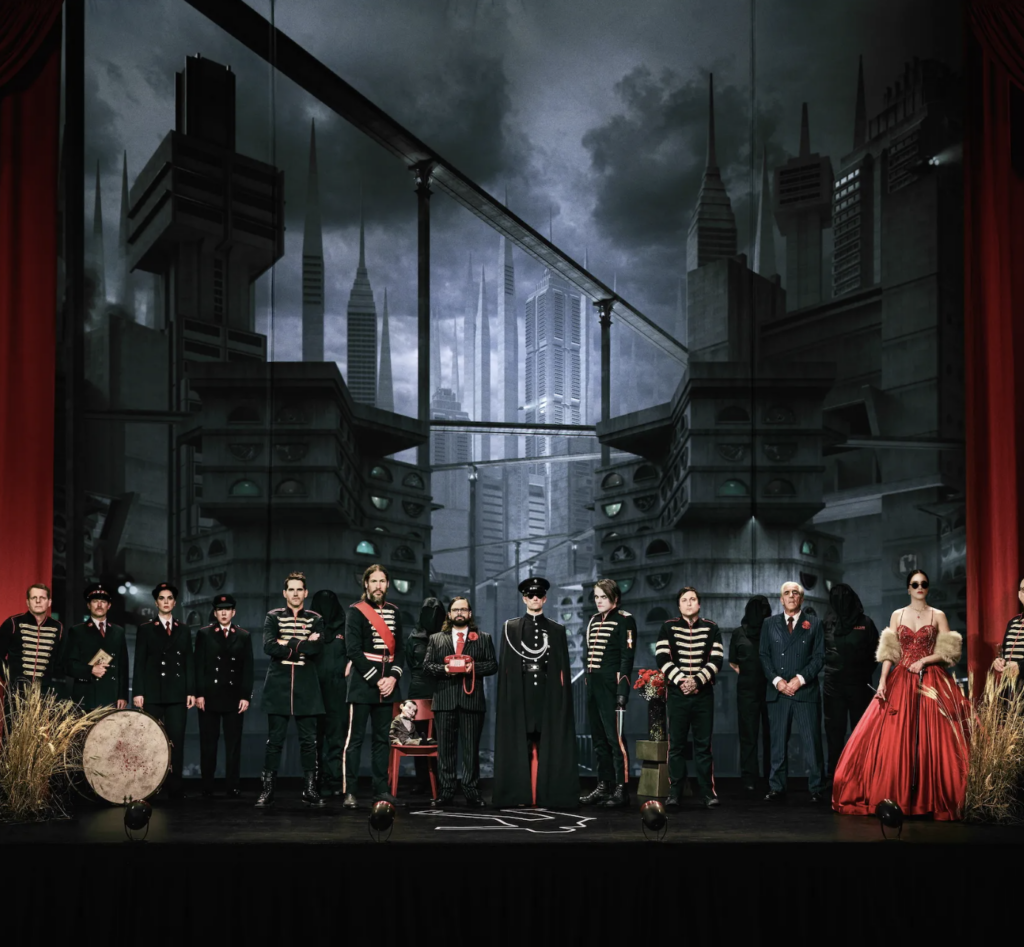
The “Long Live”: The Black Parade tour created a fictional authoritarian world that evolves between shows. There are recurring characters, propaganda, executions, elections, altered timelines, fictional ministries, and an invented written language called Keposhka that fans have been decoding since the tour began.
And I mean decoding. The language was intentionally designed to be difficult. Typographer Nate Piekos, who created Keposhka with Gerard Way, has provided enough information for fans to work through it without simply handing over a translation key.
As Piekos put it, he and Way would rather fans “have fun figuring this stuff out on your own.” Of course they would, because apparently this fandom had not been given enough extracurricular work already.
Fans documented changes between cities, built timelines, compared costumes and props, and decoded messages hidden in places as ridiculous as the care labels inside tour merchandise. They developed theories about time loops, alternate timelines and what tiny changes in a performance might signal about the larger story.
The show kept rewarding that behavior. Different cities received different visual messages, plot details shifted and characters changed.
In Toronto, voting signs suddenly said “chicken” or “fish.” In Chicago, a dagger was replaced with a fake fish, and in Boston, characters appeared to glitch while a recurring character suddenly had an eyepatch and a different name.
Normal concert stuff. Nothing to see here except several thousand fans opening spreadsheets after the show.
By the San Antonio finale on September 12, Gerard Way’s character had beheaded the Grand Immortal Dictator, run against the headless dictator in an election, and become the new leader of Draag. The band then casually added another layer of chaos when Way told the audience they had “really always wanted to make another record.”
Naturally, the MCR5 speculation machine immediately resumed operations. This fandom has been perfectly capable of behaving normally about the band for approximately zero years, so nobody should be surprised.
The interesting part is not simply that fans care deeply. It is how the tour turned that preexisting emotional investment into ongoing interpretive labor.
The Black Parade provides the institutional weight because it is a beloved album with 20 years of memory attached to it. Draag gives the audience new behavior.
Fans are not simply remembering. They are investigating.
That is what makes this different from a conventional anniversary tour. Nostalgia gets people through the door, but the new material gives them something to carry home and continue working on.
Every change creates conversation, every unexplained symbol creates content and every city adds information to a story the next audience wants before its own show. Fandom becomes part of the storytelling infrastructure.
For brands with established IP, that is a much more interesting model than endless anniversary posts. People do not necessarily want you to abandon the thing they loved, but they also do not want to be asked to applaud the exact same thing forever.
The sweet spot is continuity with consequence. Give people enough familiarity to care, then enough new information to make caring useful again.
And if that requires me to read a fan-maintained explanation of fictional authoritarian bureaucracy to prepare for a stadium concert, fine. My daughter is already named after the band, so I’m all in.
Jimothy the Raccoon Completed an Entire Brand Lifecycle Without Having a Brand Strategy

Finally, we need to talk about the raccoon. Social media spent part of this summer collectively deciding that a strangely proportioned Seattle raccoon named Jimothy was incredibly important, and having examined the available evidence, I remain convinced that the internet was correct on this particular issue.
The original video was posted July 13. Within hours, it had more than 5 million views.
Jimothy had an unusual body shape, and someone said he looked like a Jimothy. The internet accepted this instantly because apparently naming rights on social are first come, first served.
Then social did what social does when it smells lore. Within roughly a week, Jimothy had inspired a mural, an 8-bit video game, stickers, a dedicated subreddit and reported tattoos.
He appeared in the Seattle Mariners’ Salmon Run, and a Jimothy painting later sold for more than $6,500 to benefit the Ballard Food Bank. Google gave him a search Easter egg, Seattle civic leaders got involved, and the Mariners kept going.
At a certain point, Jimothy stopped being a raccoon people were sharing and became regional cultural property. Then came the baseball cards.
On August 5, the Mariners distributed Jimothy cards to the first 20,000 fans at T-Mobile Park. One was a one-of-one gold card, which ended up in the hands of a 13-year-old girl named Abby.
She put it on eBay, where the bidding started at 99 cents. One hundred bids later, the card sold for $20,100.
Please consider that value chain for a moment. A raccoon existed, someone filmed him, the internet named him, the audience created lore, artists created cultural artifacts and a professional sports franchise turned the meme into an official object.
Then artificial scarcity transformed that object into a five-figure collectible. No campaign deck was harmed in the making of any of this.
There was no six-week creative-development process, no positioning statement and no audience segmentation exercise where someone announced that the key target was “raccoon-positive Pacific Northwest millennials.” People noticed something distinctive and collectively decided it mattered.
That sequence is exactly why organic cultural moments are so valuable and so difficult for brands to manufacture. The Mariners did not create Jimothy’s relevance; they recognized it after the audience had already done the hard part.
That distinction matters because attention and permission are not the same thing. A brand can purchase enormous amounts of attention through reach, placements, creators and amplification, but cultural permission has to exist first.
The Mariners could turn Jimothy into a baseball card because the audience had already established that Jimothy belonged to them, to Seattle, and increasingly to the internet. The organization formalized an existing joke instead of asking people to care about a new one.

This is also why so many corporate attempts at “joining the meme” die immediately on contact. They skip the part where anyone granted permission.
Jimothy had permission. Jimothy also apparently had a stronger licensing strategy than many startups, so good for him.
What These Trends Actually Change for Marketers
These stories do not need to resolve into one universal theory of social. A pearl scoop and a murder trial are not strategically interchangeable, and anyone attempting to put all of this into a tidy 3×3 framework should be gently escorted away from PowerPoint.
But after three months of watching all of this accumulate, a few operating principles are hard to ignore:
- Entertainment increasingly comes before transaction. Diamond auctions and pearl reveals work because the content has value before the purchase happens. If the only interesting part of your live commerce strategy is the product, you may not actually have a live commerce strategy.
- Platform behaviors do not respect institutional boundaries. The same audience mechanics used for celebrities, creators and fictional fandoms can attach themselves to criminal trials, public-health information and other serious events. Marketers and social teams need to understand the behavior without assuming the context makes audiences behave differently.
- Perception forms cumulatively. Five unrelated recall posts can become one story about food safety. Social intelligence needs to track the narrative audiences assemble, not merely the isolated headlines organizations publish.
- Mass culture no longer requires a single mass experience. The World Cup was enormous because it supported hundreds of entry points. Cultural scale increasingly comes from fragmentation, not despite it.
- Catalog is active inventory. A 2011 Katy Perry song can generate 55 billion TikTok video views in 2026. Entertainment brands should monitor archives like living assets because audiences can restart a lifecycle whenever they find a new use for something.
- Nostalgia is stronger when it creates new behavior. My Chemical Romance did not simply replay The Black Parade. They gave fans new information to decode, distribute and debate. Memory created permission, but new lore created momentum.
- Attention is not the same as permission. Jimothy becoming famous did not automatically give every brand permission to turn him into content. The Mariners worked because the cultural relationship already made sense.
Final Thought
Before I went on leave, I probably would have described all of these stories as different kinds of attention. Three months later, I think attention is the least interesting part.
Attention is the moment someone notices the diamond auction, the trial, the old song, the fictional language, or the strangely shaped raccoon. The more important part is what happens after people decide the thing deserves their participation.
Audiences take things and change their category. They turn shopping into television, products into games, legal proceedings into serialized social narratives, individual health alerts into collective anxiety, sporting events into thousands of parallel fandoms and anniversary tours into participatory fiction.
Sometimes they turn a raccoon into a $20,100 baseball card. Social remains a deeply serious field of study.
That is the part marketers need to get better at seeing. Social intelligence cannot stop at what are people talking about? because conversation is only evidence that attention happened.
The more useful question is what are people turning it into? Once audiences start participating, interpretation itself becomes value.
Three months away from social strategy taught me one other thing, too. Apparently, I am physically incapable of not doing social strategy, even while holding a newborn at 4 a.m. and bidding on a loose diamond I absolutely did not need.
At least I came back with notes. And diamonds.
Are TikTok diamond auctions actually a good deal?
Sometimes, but a low winning bid does not automatically mean you just found the diamond equivalent of an estate-sale Picasso. Lab-grown diamond prices have fallen dramatically, so stones selling for surprisingly low prices can still reflect the broader market, and the real value depends on carat weight, cut, color, clarity, grading and what comparable stones are selling for elsewhere. What TikTok has done exceptionally well is make the possibility of getting a deal entertaining enough that people will watch auction after auction even when they have absolutely no practical need for another loose diamond.
Are the pearls sold on TikTok Live actually real?
Many of the pearls being sold through TikTok livestreams are real cultured pearls, including freshwater varieties, but “real” does not automatically tell you anything about quality, value or whether the price is good. Pearl type, nacre quality, size, shape, luster and surface quality all matter, and while the old tooth test can help distinguish some imitation pearls from nacre, it is not a substitute for actual gemological identification. I knew my COVID-era pearl certification would become professionally relevant eventually.
How did TikTok affect the Lindsay Clancy trial?
TikTok did not simply cover the Lindsay Clancy trial; it built a parallel social ecosystem around it. Creators livestreamed analysis, attorneys and witnesses developed fandoms, supporters organized courthouse demonstrations, money was raised through social communities, conspiracy theories spread rapidly, and people increasingly consumed a real criminal proceeding using many of the same behaviors they bring to serialized entertainment.
That distinction matters because the consequences remained very real. The case became an unusually stark example of what happens when platform incentives reward constant interpretation, new characters and escalating theories around a story where the people being discussed cannot log off from the outcome.
Why did it feel like so much food was being recalled in Summer 2026?
There were multiple significant food-safety investigations happening around the same period, including Cyclospora linked to iceberg lettuce as well as separate outbreaks involving blueberries and sprouts. They were not one giant connected recall event, but social feeds compressed those unrelated investigations into a continuous stream of warnings that made it feel like the entire produce aisle had personally declared war on us.
That perception is part of the social-media story. Algorithms are very good at aggregating separate events into what feels like a single cultural pattern, particularly when every new headline reinforces something you have already begun noticing.
How big was the 2026 World Cup on social media?
Enormous. TikTok reported more than a trillion views around World Cup content, while platforms including Instagram, WhatsApp and broadcaster livestreams turned the tournament into a global second-screen event operating alongside the matches themselves.
The more interesting shift was that social participation was not peripheral to watching the World Cup. Highlights, player accounts, memes, livestreams, digital collectibles and fan commentary became part of how hundreds of millions of people experienced the tournament, meaning the audience around the game increasingly mattered almost as much as the broadcast of the game.
Why are old songs suddenly becoming hits again on TikTok?
Because recommendation algorithms do not particularly care when a song was released. If an older track suddenly fits a meme, emotional format, edit style or nostalgic moment, TikTok can introduce it to millions of people who either forgot about it or were too young to encounter it the first time.
Katy Perry’s “The One That Got Away,” originally released in 2011, becoming TikTok’s Song of the Summer in 2026 is a particularly clean example. Catalog music is no longer dormant inventory waiting for an anniversary campaign; on social, any song can become culturally current again if audience behavior gives the algorithm a reason to resurface it.
Is Ravenforge an AI-generated band?
Ravenforge operates less like a traditional band and more like an AI-native music property, with synthetic-looking Viking characters, a rapidly expanding catalog and an interconnected universe that includes separately credited digital artists such as Draugr Balled. The project uses all the familiar signals of artist culture, including streaming profiles, releases, recurring visual identities and collaborations, even though the performers themselves do not behave like a conventional human lineup.
That is precisely why it is interesting. Ravenforge shows how generative tools can move beyond creating individual songs and start manufacturing the surrounding architecture of an artist identity, including characters, lore, visuals, collaborations and enough output to make a relatively new property look surprisingly established.
What is Draag in My Chemical Romance’s 2026 tour?
Draag is the fictional authoritarian world My Chemical Romance built around its 2026 tour, complete with symbols, propaganda, language, characters and details that changed from city to city. Fans responded by decoding merchandise, performances and visual clues, effectively turning a legacy-rock tour into an ongoing participatory story.
That is what made the campaign more interesting than nostalgia alone. My Chemical Romance had decades of emotional equity to draw from, but Draag gave existing fans something new to investigate together, proving that nostalgia can get people through the door while new mythology gives them a reason to keep paying attention.
Who is Jimothy the raccoon, and why is he famous?
Jimothy is a Seattle raccoon who became one of Summer 2026’s most improbable cultural properties after a viral video turned him into a local celebrity. What started as internet affection expanded into artwork, tattoos, a video game, Mariners activations, a Google Easter egg and a one-of-one baseball card that ultimately sold for more than $20,000.
The important part is that no brand invented Jimothy and then asked an audience to care. The audience cared first, built the mythology itself, and institutions like the Mariners followed once that affection had already created permission. That sequence is worth remembering the next time someone tries to manufacture a “viral mascot” in a conference room.
A note on sourcing: Because several of these stories were moving quickly while I was writing, I prioritized primary sources for hard numbers and platform data, reported journalism for quotes and documented behavior, and community sources like Reddit only when the point is specifically about what audiences are saying or experiencing. In a few places, particularly around TikTok behavior I personally observed, I’ve labeled those observations as exactly that rather than pretending every strange thing the algorithm served me has a corresponding peer-reviewed citation. This is, after all, an article that contains AI Vikings, loose diamonds and a famous raccoon. There are limits to institutional documentation.
Lab-Grown Diamond Auctions
- Rings.com Lab-Grown Diamond Price Index
https://rings.com/pages/lab-grown-diamond-price-index - Rings.com: How Much Does a Lab-Grown Diamond Cost?
https://rings.com/pages/how-much-does-a-lab-grown-diamond-cost - The Guardian: TikTok Auctions for Lab-Grown Diamonds
https://www.theguardian.com/technology/2026/aug/22/tiktok-auctions-lab-grown-diamonds
Pearl Livestreams
- Pearlism TikTok Shop
https://shop.tiktok.com/us/store/pearlismjewel/7496030182441585510 - Pearlism Luck Pearl Scoop
https://shop.tiktok.com/us/pdp/luck-pearl-scoop-by-pearlism-exquisite-selection-unique-design/1732054424444703590 - Pearlism Freshwater Pearl Wire-Wrapping Bangle
https://shop.tiktok.com/us/pdp/freshwater-pearl-wire-wrapping-bangle-custom-jewelry-pearlism/1731417405531853670 - Pearlism AK Pearl Clam
https://shop.tiktok.com/us/pdp/adee-freshwater-ak-pearl-clam-10-ak-pearls-1-edison-pearl/1732275064390456166 - ELLE: Pearls Have Gone Punk
https://www.elle.com/fashion/jewelry/a73494360/pearls-have-gone-punk-fashion-trends/ - GIA: Majorica Imitation Pearls / Pearl Identification
https://www.gia.edu/doc/Majorica-Imitation-Pearls.pdf
Lindsay Clancy Trial and Social Media
- CT Insider: Lindsay Clancy Trial and Social Media
https://www.ctinsider.com/news/article/lindsay-clancy-trial-social-media-ct-22394622.php - Boston Globe: Lindsay Clancy Trial and Media
https://www.bostonglobe.com/2026/09/04/business/lindsay-clancy-trial-media/ - TheWrap: Lindsay Clancy Trial, Social Media and True Crime
https://www.thewrap.com/media-platforms/journalism/lindsay-clancy-trial-social-media-true-crime/ - CT Insider: Kevin Reddington’s TikTok Fans
https://www.ctinsider.com/news/article/lindsay-clancy-lawyer-kevin-reddington-tiktok-fans-22412329.php - Boston Globe: Lindsay Clancy Supporters Outside Courthouse
https://www.bostonglobe.com/2026/08/20/metro/lindsay-clancy-supporters-courthouse-demonstration/ - CT Insider: Lindsay Clancy Parents GoFundMe
https://www.ctinsider.com/news/article/lindsay-clancy-parents-gofundme-1-million-22398902.php - The Guardian: Lindsay Clancy, Conspiracy Theories and Postpartum Psychosis
https://www.theguardian.com/us-news/2026/aug/17/lindsay-clancy-trial-conspiracy-theories-postpartum-psychosis - The Guardian: Lindsay Clancy Trial and Social Media Conspiracy Theories
https://www.theguardian.com/us-news/2026/aug/24/lindsay-clancy-trial-social-media-conspiracy-theories - CT Insider: Emily Thorndike, TikTok and Courtroom Fallout
https://www.ctinsider.com/news/article/lindsay-clancy-emily-thorndike-tiktok-apology-22397858.php - Boston Globe: Brittany Romano / “Green Dress Girl”
https://www.bostonglobe.com/2026/08/25/metro/lindsay-clancy-trial-vanity-fair-reporter-brittany-romano/ - TMZ: Brittany Romano Explains Viral Courtroom Moment
https://www.tmz.com/2026/08/25/brittany-romano-creepy-smile-at-lindsay-clancy-trial/
PPD vs. PPP
- Royal College of Psychiatrists: Postpartum Psychosis
https://www.rcpsych.ac.uk/mental-health/mental-illnesses-and-mental-health-problems/postpartum-psychosis - PubMed: Differentiation and Clinical Implications of Postpartum Depression and Postpartum Psychosis
https://pubmed.ncbi.nlm.nih.gov/19538615/
Cyclospora and Food Recalls
- FDA: Multistate Cyclospora Outbreak Linked to Iceberg Lettuce
https://www.fda.gov/food/outbreaks-foodborne-illness/investigation-multistate-outbreak-cyclospora-illnesses-iceberg-lettuce-july-2026 - CDC: Cyclospora Cases
https://www.cdc.gov/cyclosporiasis/cases/index.html - FDA: Current Foodborne Illness Outbreak Investigations
https://www.fda.gov/food/outbreaks-foodborne-illness/investigations-foodborne-illness-outbreaks - FDA: Recalls, Market Withdrawals and Safety Alerts
https://www.fda.gov/safety/recalls-market-withdrawals-safety-alerts - FDA: E. coli Outbreak Linked to Frozen Blueberries
https://www.fda.gov/food/outbreaks-foodborne-illness/outbreak-investigation-e-coli-o145h28-frozen-blueberries-july-2026 - CDC: Alfalfa Sprout Outbreak Investigation
https://www.cdc.gov/ecoli/outbreaks/alfalfa-sprouts-08-26/investigation.html - FDA: E. coli and Salmonella Sprout Investigation
https://www.fda.gov/food/outbreaks-foodborne-illness/outbreak-investigation-shiga-toxin-producing-e-coli-salmonella-sprouts-august-2026 - FDA: Salmonella Sprout Investigation, September 2026
https://www.fda.gov/food/outbreaks-foodborne-illness/outbreak-investigation-salmonella-sprouts-september-2026
FIFA World Cup 2026
- TikTok Newsroom: FIFA World Cup 2026 Content Reaches More Than 1 Trillion Views
https://newsroom.tiktok.com/fifa-world-cup-2026-content-reaches-more-than-1-trillion-views-on-tiktok?lang=en - Meta: The 2026 Summer of Football
https://about.fb.com/news/2026/07/the-2026-summer-of-football-a-record-breaking-moment-across-meta/
2016 Core and Catalog Music Revival
- ListenFirst: Quick Dip, 2016 Core
https://www.listenfirstmedia.com/quick-dip-2016-core/ - TikTok Newsroom: Katy Perry’s “The One That Got Away” Named Song of the Summer 2026
https://newsroom.tiktok.com/tiktoks-global-and-us-song-of-the-summer-2026-katy-perrys-the-one-that-got-away?lang=en
Ravenforge / AI Viking Music
- Ravenforge: “Runes in the Storm”
https://open.spotify.com/track/1h9KuJgrvDnwScACGoYpGh - Ravenforge: Crown of Storms
https://open.spotify.com/intl-es/album/1oB4GwYJxFInQ7sT9bTxCN - Ravenforge: “Runes in the Storm” Single
https://open.spotify.com/intl-ja/album/2Jz1GALoyFEepUbt4bBzxP - Draugr Balled Spotify
https://open.spotify.com/artist/7zEyGwOvYq5KkBn4MUuL1g - Draugr Balled YouTube
https://www.youtube.com/@DraugrBallad - Draugr Balled Linktree
https://linktr.ee/draugrballed - Reddit: Discussion of AI-Generated Viking/Norse Music
https://www.reddit.com/r/isthisAI/comments/1tby0sf/i_have_discovered_a_surge_in_viking_norse_music/
My Chemical Romance / Draag
- My Chemical Romance Official Site
https://www.mychemicalromance.com/ - Alamodome: My Chemical Romance Announcement
https://www.alamodome.com/news/detail/my-chemical-romance-announce - Alamodome: Know Before You Go, My Chemical Romance
https://www.alamodome.com/news/detail/know-before-you-go-my-chemical-romance - Loudwire: MCR’s Draag Explained
https://loudwire.com/my-chemical-romance-draag-explained/ - Loudwire: MCR5 Speculation After Tour Finale
https://loudwire.com/my-chemical-romance-mcr-5-north-american-tour-finale/
Jimothy
- Axios Seattle: Jimothy Becomes a Seattle Phenomenon
https://www.axios.com/local/seattle/2026/07/20/seattle-viral-raccoon-jimothy-mural-video-game-mariners-tattoos-fandom - Axios Seattle: Google Gives Jimothy a Search Easter Egg
https://www.axios.com/local/seattle/2026/07/23/google-jimothy-raccoon-easter-egg-search-animation-seattle - MLB: Jimothy Wins the Mariners’ Salmon Race
https://www.mlb.com/news/jimothy-the-raccoon-wins-mariners-salmon-race - Seattle Mariners: Jimothy Promotion
https://www.mlb.com/mariners/tickets/specials/jimothy - MLB: Mariners Unveil Jimothy Baseball Card
https://www.mlb.com/mariners/video/mariners-booth-unveils-jimothy-baseball-card - Washington Post: People Are Obsessed With Jimothy
https://www.washingtonpost.com/lifestyle/2026/07/23/people-are-obsessed-with-jimothy-seattle-raccoon-whos-now-celebrity/ - Washington Post: Jimothy Art and Seattle City Hall
https://www.washingtonpost.com/lifestyle/2026/07/28/prize-best-art-jimothy-place-seattles-city-hall/ - People: Teen Sells Ultra-Rare Jimothy Mariners Card for More Than $20,000
https://people.com/teen-sells-ultra-rare-jimothy-mariners-card-for-over-20000-dollars-12116299/