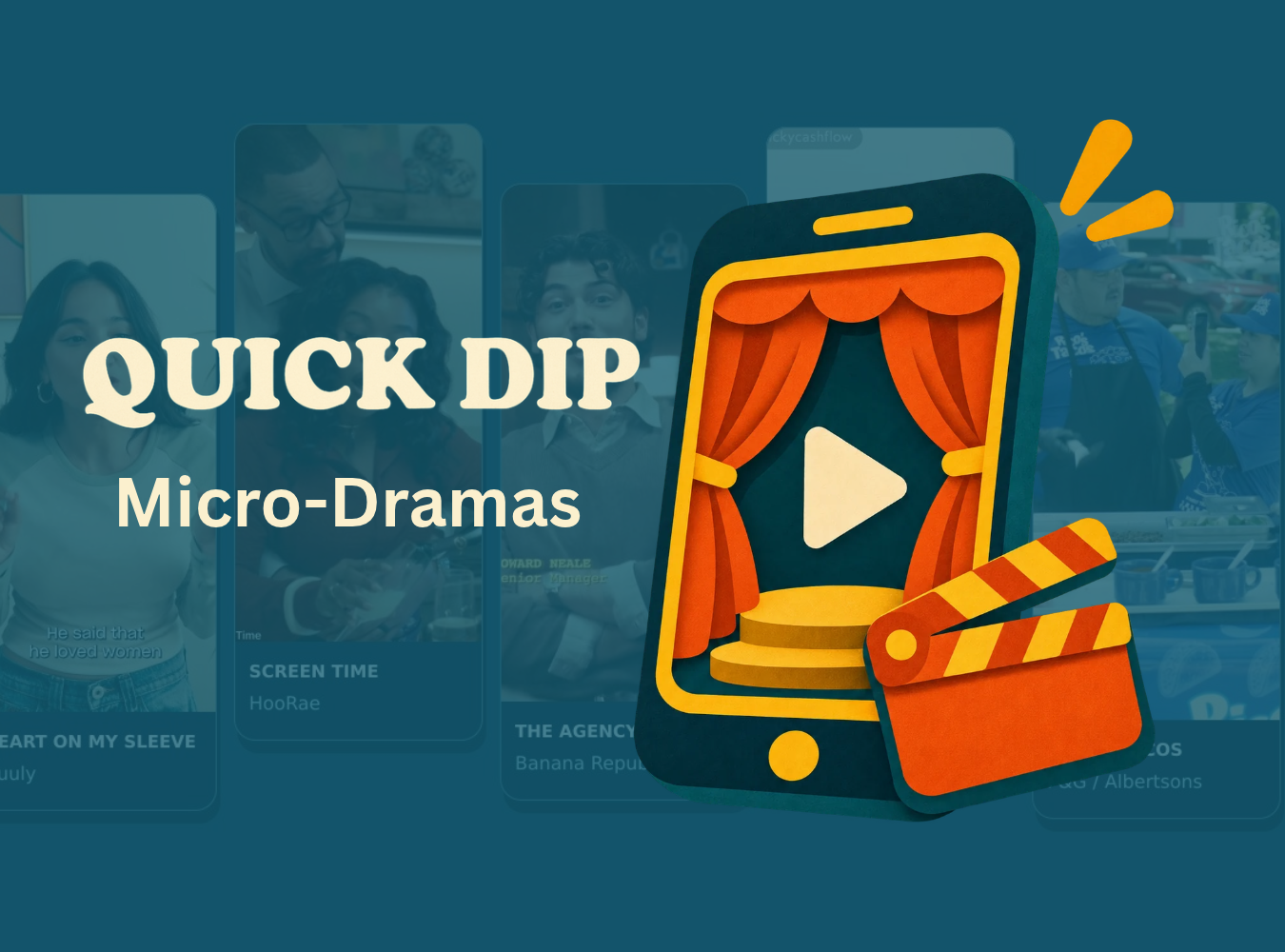
Brands are turning to episodic storytelling. Getting viewers to come back is the real challenge.
A branded micro drama might begin with a product, but a successful series needs a reason for audiences to watch the next episode. And the next one. And, if things go really well, an entirely new season.
We analyzed 13 branded series across social platforms, from Maybelline’s Maybe This Christmas to InStyle’s The Intern and Alexis Bittar’s Margeaux and Jules, to see how release strategy, creative, and distribution influence performance. The takeaway? Getting the first view and building an audience are two different jobs.
The Episode Three Problem
The premiere may get the biggest push, but maintaining that momentum is where things get interesting. Across the series included in our episode fall-off analysis, average viewership dropped 47% after the first episode. Episode three marked another significant dip, with views falling 56% from the preceding episode. From the first episode to the last, the average decline was 76%.
Those figures don’t include series with fewer than five episodes, The Intern, or Margeaux and Jules. They do show why retention needs to be part of the plan from the start, particularly for brands releasing episodes over several weeks.

Teasers, community engagement, and episode-ending hooks can give audiences a reason to return between posts. Paid support and collaboration tools can also help extend reach beyond the initial launch. The key is to plan for the middle of the season, not just the premiere.

TikTok Leads Discovery, but Distribution Still Matters
TikTok generated the highest average viewership for nine of the 13 series in our analysis, averaging 2.4 times the viewership of Instagram. Its audience is already accustomed to fast-paced, serialized stories, making it a natural place for viewers to discover a new series.
Where that series lives matters, too. HooRae’s Screen Time made all 57 episodes available for free through TikTok’s Micro Series app and averaged approximately 4.6 million views per episode across the social data tracked, including an estimated 3.4 million organic views. The accessible format made it easier for viewers to move from one episode to the next.
On the other end, P&G and Albertsons’ Rico’s Tacos and Crocs’ Déjà Shoe ran on standalone accounts rather than the brands’ main pages. Both were among the lower performers in views and engagement, suggesting the built-in reach of an established brand audience can make a difference.
Paid support is also part of the picture. Maybelline’s Maybe This Christmas accounted for 89% of total YouTube viewership across the series analyzed, with its performance heavily influenced by paid support. A large view count can show the scale of a campaign, but it shouldn’t be treated as a direct measure of organic demand.
Give Audiences Someone to Come Back For
A cliffhanger can carry viewers into the next episode. A memorable character can give them a reason to keep showing up across an entire season, or several.
InStyle’s The Intern has expanded across nine seasons and spin-offs, using humor and rotating influencer talent to keep its world moving. Alexis Bittar’s Margeaux and Jules has built an eight-season universe around recognizable characters, with self-contained episodes that give new viewers a place to jump in.
Talent choice played a role across the broader analysis, too. Series featuring actors or influencers generated 3.7 times the average video response rate of celebrity-led series across channels. That comparison was likely influenced by paid-supported celebrity campaigns, including Maybe This Christmas, so it’s best read as directional rather than proof that one type of talent always wins.

The finding does raise a useful question for marketers: Is the audience coming for a recognizable name, or is there a character they’ll want to follow after the first appearance?
How Long Should an Episode Be?
In our sample, episodes under one minute were more effective at driving views, while episodes between one and two minutes tended to generate stronger engagement relative to views. Shorter episodes can give new audiences a low-commitment introduction, while a little more time gives invested viewers room to follow the story.
Episode length wasn’t available for every post, so this comparison is based on a manually pulled sample and should be interpreted directionally. It’s a useful creative consideration, not a universal rule.
A Personal Note: Quibi Walked So Micro Dramas Could Run
Do you remember Quibi? Don’t lie!

Quibi was a short-form video platform that launched in April 2020 and went defunct that December. What a ride. The idea was to give people premium, bite-sized shows to watch on their phones while they were on the go. Unfortunately, launching a service built around commuting and waiting in line right as a global pandemic kept everyone at home wasn’t exactly ideal. Add in free competition from TikTok and YouTube, and Quibi struggled to build the subscriber base it needed. The service shut down on December 1, less than eight months after launch. In January 2021, Roku acquired the distribution rights to its content library.
Back in the day, years before Quibi launched, I worked for an independent music trade organization where one of our members was on the Quibi founding team. We were given a presentation on the project and how they planned to release vertical movies in 10-minute pieces, one week at a time.
Baby Chase thought, “Who the hell wants to watch a movie on their phone in 10-minute pieces?”
Egg on my face, huh? Who knew TikTok would become what it did, and micro-dramas would take off the way they have?
Looking back, Quibi was clearly ahead of its time, even if its particular approach didn’t work. It had to walk, trip, and crash so TikTok could sprint. And it’s a good reminder that sometimes being first doesn’t make you the winner. Sometimes it makes you the sacrificial lamb for the cultural slaughter, clearing the way for someone else to figure out what audiences actually want. The world of social media constantly proves this theory. Did the influencer go viral because of a totally original idea? Maybe. But if you trace long enough, you may find a small profile with 300 followers who posted it long before them, only for it to be stolen by someone with a larger platform.
Maybe imitation is the sincerest form of flattery, but that doesn’t make it any less frustrating when someone else gets the credit for your idea. TikTok didn’t need to live through its own Quibi phase to find success with short-form video. It found what worked for its audience and ran with it. The internet builds on what came before, and yes, we should always give credit where it is due. But let’s be real: no one is giving Quibi credit, even if they deserve it.
The Takeaway
Micro dramas give brands room to build stories and characters that can live beyond a single campaign. But a strong premiere is only the beginning. The series still needs a plan for reaching new viewers, keeping existing ones interested, and making it easy for someone who finds episode four first to understand why they should stay.
The brands getting the most out of the format are thinking about the entire viewing experience: where the series lives, how episodes connect, what paid support contributes, and who audiences will want to see again.