

Every year, the ListenFirst strategy team puts together a monster report on the Super Bowl, distilling what actually broke through across platforms, moments, and brand plays — not just what aired between downs. Here is a deep dive into the report, with some extra spice on the controversy that dominated the news cycle before and after the game.
Click here to download the full Super Bowl LX report.
The post-Travis era has begun.
Super Bowl LX was never going to match the viral combustion of LVIII, when Taylor Swift and Travis Kelce turned a football game into a full-season reality show saga. But the 2026 edition found its footing elsewhere. Bad Bunny delivered the most talked-about halftime performance of the past decade. Latin American audiences showed up louder than ever. And while tech brands outspent everyone on ad buys, they were drowned out by nostalgia, fandom, and a yellow electric mouse.
In short: the vibes were global. The ads were forgettable. And culture keeps winning.
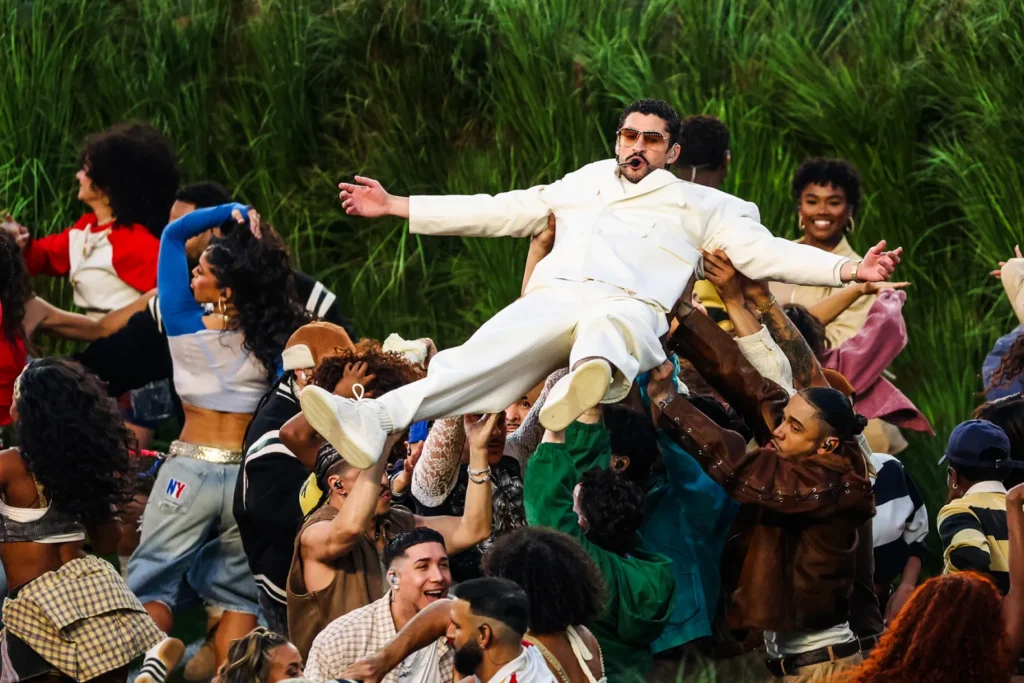
What’s Happening: Halftime eclipses the game, again
Bad Bunny’s halftime show logged 6.2M+ mentions, topping not just last year’s Kendrick Lamar performance but even Queen Bey’s 2013 show by 14%. Surprise cameos from Lady Gaga and Pedro Pascal turned it into a crossover meme machine, and Spanish-speaking audiences drove a 13-point increase in conversation share since 2025.
It also beat the game itself. Bad Bunny’s halftime show averaged 128.2 million U.S. viewers, compared to 124.9 million for the game. On social, it pulled in 4 billion views in 24 hours, with 55% of that audience outside the U.S.
The ListenFirst data backs it up: Bad Bunny added 5.3M new followers in the weeks around the game — a 999% increase from the month prior. His public video views surged to 81.5M, while total engagement topped 33.1M, including a 34% TikTok response rate and standout posts logging over 13M and 12M interactions respectively.
At the same time, negativity around the show stayed low. Positive sentiment jumped 15% year-over-year. It helps when you’re Bad Bunny at the peak of your imperial phase.
Even the backlash felt like a rerun. The Atlantic’s tongue-in-cheek dispatch from the Turning Point USA counter-show skewered the culture war fatigue around “real American halftime,” mocking the idea that a Puerto Rican artist could somehow be un-American.
But the real meme fuel came from country singer Lee Brice, who debuted a song titled “Country Nowadays” during the TPUSA broadcast. Intended as a nostalgic lament, it quickly turned into a punchline. The lyrics, lamenting how “they don’t sing about trucks anymore,” were relentlessly dunked on across TikTok and Twitter. One viral post called it “the musical version of yelling at a cloud.” Another zeroed in on the absurdity of Brice’s grievance: “I just want to cut my grass, feed my dogs, wear my boots” — as if anyone, anywhere, was stopping him. The internet responded accordingly. For many, it captured the underlying tone of the TPUSA halftime show: nostalgic for a version of America no one is actually preventing.
Between Kid Rock’s lip-syncing and Brice’s unironic chorus about missing the old days, the TPUSA show became the internet’s favorite cultural chew toy — less halftime, more heritage cosplay.
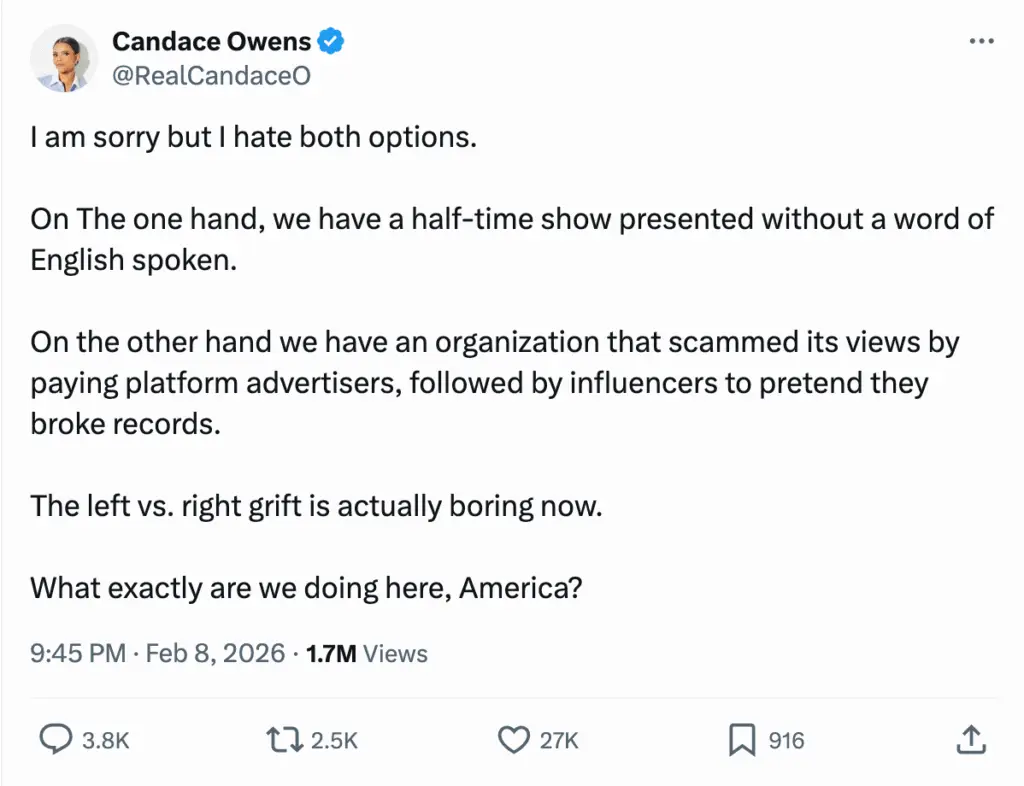
Even some conservatives weren’t buying it. Former TPUSA communications director Candace Owens took to X to accuse the organization of faking its viewership numbers, calling out its use of paid traffic and influencer amplification as attempts to manufacture virality. Her post read, “We have an organization that scammed its views by paying platform advertisers, followed by influencers to pretend they broke records.”
Brands, this is your cue: High spend ≠ high impact
Ad-wise, Film & TV saw reduced representation this year, dropping to just 9% of total commercial share. That’s less a fall from grace and more a reflection of shifting priorities — with fewer blockbuster tentpoles on the calendar and more modest campaigns replacing the big-budget franchise showcases of previous years. But they still claimed 19% of ad conversation, overperforming by 113%.
The most talked-about ad? Pokémon. Celebrating its 30th anniversary, the brand reminded everyone why it’s still one of the most agile franchises in media. Pokémon didn’t just rely on nostalgia — it paired a clear, celebratory message with well-timed, high-volume social content. The brand added 192K new followers across platforms in the lead-up to and aftermath of the game, while total engagement topped 3.85M. Its best performing content — a LEGO crossover post — earned over 341K interactions. Public video views reached 9.72M, and the brand posted a total of 91 times across its active channels during the campaign window.
For entertainment marketers, there’s a clear takeaway: frequency + fan payoff still works. But only if the creative understands its community. Pokémon didn’t just drop a commercial — it ran a surround-sound campaign rooted in playful creative, active storytelling, and a fanbase primed to amplify it. If you’re not bringing the audience into the moment, you’re probably just buying impressions. Not OpenAI. Not Ring. Not even Budweiser, though it did pull classic numbers through nostalgia and patriotism. Pokémon outpaced them all.
Meanwhile, Tech/AI brands claimed 20% of ad share but netted just 7% of the conversation — a brutal -66% underperformance. Even with saturation-level presence, many of these spots felt forgettable, vague, or out of step with the tone of the moment. Ring’s surveillance-themed ad was the most discussed tech spot, although the conversation was mixed. Some praised the production and clever use of suspense, while others raised eyebrows at the normalization of at-home surveillance. The spot sparked thoughtful debate. Not full backlash, but enough unease to complicate any clean brand win.
TL;DR: Big spenders, soft landings.
Global Audience Shifts: The Super Bowl Is No Longer Just America’s Game
While domestic attention remains high, this year’s data makes one thing clear: the Super Bowl is becoming a global content event — especially on social.
Over 55% of social views on Bad Bunny’s halftime performance came from outside the U.S., and Latin American audiences drove a significant surge in real-time participation. Fans in Mexico, Brazil, and Colombia posted in record volume, with Spanish-language engagement contributing to a 13-point share increase over 2025. This wasn’t just a regional bump — it was a signal of where the NFL’s attention economy is headed.
Platforms like TikTok, where language and geography matter less than trend fluency, amplified this shift. The biggest audience spikes didn’t align neatly with traditional broadcast reach. They followed fan culture, remixability, and global relevance.
For U.S.-based marketers, this means rethinking what “national campaigns” actually touch — and who’s watching.
It also mirrors the NFL’s own global ambitions. Commissioner Roger Goodell reiterated just before the game that international expansion remains “very possible,” including the idea of a permanent team outside the U.S. or even an eventual European or Pacific division. The league’s global push, which began in earnest in 2007 with international games, isn’t a side project — it’s part of a long-term play to transform the NFL from a billion-dollar enterprise into a trillion-dollar one. From halftime choices to franchise futures, the Super Bowl is increasingly a staging ground for that vision.
The Winners Circle: Who Actually Won the Internet
Sometimes it helps to lay it out plain. Here’s who dominated:
| Category | Winner | Why It Won |
| Halftime | Bad Bunny | Global reach, fandom fluency, zero English, total dominance |
| Ad | Pokémon | Nostalgia meets execution; multichannel lift across metrics |
| Meme | Lee Brice Lyrics | Cringe virality + cultural dissonance = pure internet bait |
| Platform | TikTok | Drove the Seahawks’ top posts and best halftime engagement |
| Alt-Show LOLs | TPUSA | Lip-sync fails, inflated stats, and self-parody visuals |
For marketers, the 2026 Super Bowl underscores a few non-negotiables:
- Cultural alignment beats category dominance. Pokémon, BLACKPINK, and even Minions outshone brands with bigger budgets because they were contextually fluent. They knew how to read the room.
- Latin audiences are not a niche. Their conversation share is growing year over year across both game and halftime mentions. That shift isn’t temporary.
- Tech brands need a tone check. Many leaned on abstract future-speak or self-serious worldbuilding. The winners spoke in clear, emotional, fan-centric language.
The platforms didn’t drive the story. TikTok powered the Seahawks’ top promotional posts, but the real juice came from the creative itself.
Click here to download the full report.
Final Thought:
If 2025 was the year the Super Bowl became a SwiftTok soap opera, 2026 reminded us that culture is still platform-proof. Not every brand needs a Bunny, but every brand does need a point of view. If you can’t be in the moment, at least understand what moment you’re in.