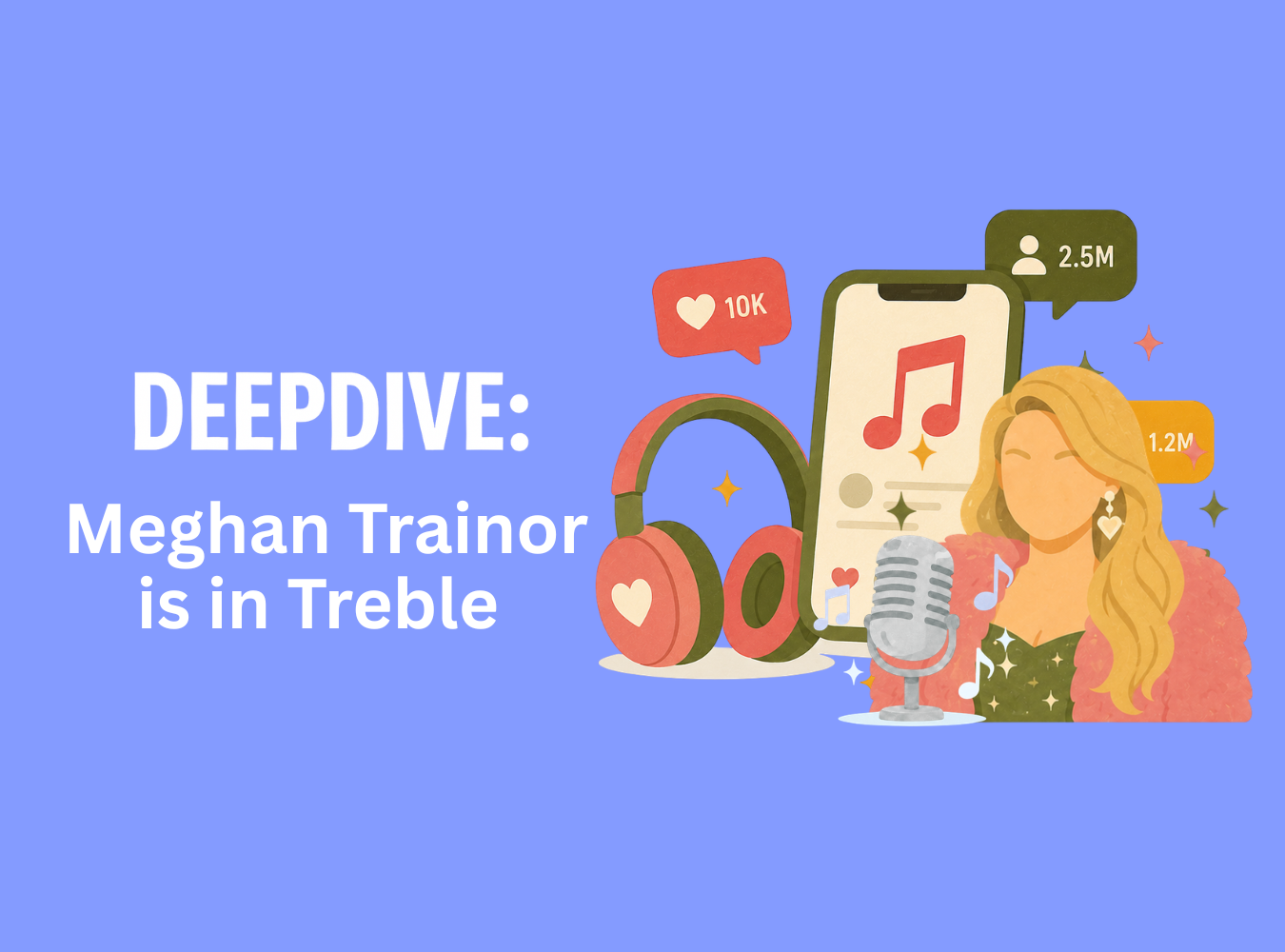
Meghan Trainor’s new album & era became a case study in what happens when audiences start treating pop rollouts like brand audits.
Meghan Trainor may have canceled The Get In Girl Tour for personal reasons. But on social media, the cancellation was quickly absorbed into a more embarrassing narrative: another pop artist overestimated demand, booked a tour too big for the moment, and got exposed by the blue dots.
That is the more interesting marketing story. Not because the official reason does not matter, but because social media rarely lets official reasons own the conversation for long. Once audiences decide the real story is weak ticket demand, the press release becomes the PR layer over the story people are already telling each other.
Trainor announced the cancellation on April 17, explaining that balancing a new album release, a nationwide tour, and a new baby girl in a family of five had become “more than I can take on right now.” Her seventh studio album, Toy with Me, was still set for an April 24 release, and she and Daryl Sabara had welcomed their third child, Mikey Moon, via surrogate in January.
For Meghan, that perception problem landed in an already fragile era. The new music was being criticized as derivative. The visuals were being compared to younger pop stars. Her body transformation and surrogacy story were being folded into older conversations about body positivity. And the tour cancellation gave all of those critiques a single social-media-friendly conclusion: maybe the market was not buying this version of Meghan Trainor.
The real reason for the cancellation may lie with the artist. The perceived reason belongs to the internet.
What’s Happening?
What is Blue Dot Fever?
“Blue Dot Fever” is an unofficial, social media-driven term used to describe the widespread cancellation or poor ticket sales of major 2026 concert tours
“Blue Dot Fever” is brutal because it turns ticketing into public evidence. The phrase refers to the visible unsold seats on Ticketmaster maps, where available inventory appears as blue dots. Page Six framed Meghan Trainor, Post Malone, Zayn Malik, and the Pussycat Dolls as part of a broader cancellation and postponement conversation around visible ticketing anxiety, even as artists cited different official reasons for their decisions.
That distinction matters. Nobody outside the room should pretend to know the full financial, logistical, or personal reasoning behind a tour cancellation. Health, family, timing, production, and creative priorities are all real. But social media does not operate like a deposition. It operates like a perception market.
Fans do not need internal sales reports when they can pull up a seating chart, see rows of available seats, and build a narrative from what is visible. Screenshots become reputation data. Empty sections become content. The official explanation becomes something audiences interpret, not something they automatically accept.
When the perceived reason is embarrassing, the official reason has to work twice as hard and usually still loses.
That is particularly dangerous for artists because demand is tied to status. A soft-selling tour does not just look like a business problem. It can look like social rejection. In pop, a sold-out room is never just a room. It is proof that the artist still matters enough for people to leave the house, spend the money, post the outfit, and participate in the ritual.
Meghan is not alone in being pulled into this larger story. Recent coverage has grouped together a wave of canceled or postponed 2026 tours from artists citing different reasons, including family commitments, health issues, creative timing, and production or logistical concerns.
Social media, naturally, flattened that nuance. Once multiple artists cancel, postpone, or scale back in the same window, the internet connects them into one story: tickets are expensive, venues are ambitious, and some artists may be overestimating how much demand they can command.
When an artist privately overestimates demand, it is a forecasting problem. When they do it publicly, it becomes content.
Brand and Marketer Implications
The Meghan Trainor conversation is really about the gap between visibility and urgency.
Plenty of people know Meghan Trainor. Plenty remember “All About That Bass,” “Lips Are Movin,” and “Made You Look.” Plenty will watch a TikTok, comment on a controversy, or recognize her from a podcast clip, brand partnership, or holiday television appearance. None of that automatically means they will buy two tickets, pay fees, arrange childcare, pay for parking, and spend a night inside that artist’s current world.
A tour is where brand perception becomes a purchase decision. It is one thing to recognize an artist. It is another to believe the artist’s current era is worth premium-event pricing.
This is the problem many artists are running into after the Taylor Swift touring economy. Every artist wants the cultural gravity, not just the tour. Taylor trained the market to accept stadium pricing, multi-night runs, fan rituals, travel, friendship bracelets, merch hauls, catalog archaeology, and expensive tickets as part of a once-in-a-generation event. But that model is not plug-and-play.
Having worked in music marketing and artist branding for more than a decade, I’ve seen how often artists, teams, and labels mistake visibility for demand. Every generation has one or two artists who rise so high that the rest of the industry starts treating their success like a replicable model. Right now, Taylor Swift is that north star.
You could hand another artist the same playbook, the same staff, and the same rollout mechanics, and it still would not produce the same result while the original north-star artist is active.
The problem is not ambition. Artists should want bigger rooms, stronger fan conversion, and more culturally resonant eras. The problem is when the industry confuses aspiration with market reality. Trying to scale like Taylor Swift does not make an artist Taylor Swift. It can, however, set an artist up for disappointment, soft sales, and bad PR when the attempt happens publicly and audiences start connecting the dots, whether the comparison is fair or not.
Fame is not the same as urgency. A recognizable catalog does not automatically create a must-attend event.
Personal Note: Hope You Brought a Snack
I want to be clear about something: I do not think Meghan Trainor is talentless, clueless, or uniquely guilty of some grand pop crime. That is the lazy version of this conversation, and honestly, it is the least interesting one.
People connect to the artist, sometimes before they really connect with the catalog. But in pop, artists are often expected to fit the mold they arrived in forever. That is why the debut matters so much. The first album is not just a collection of songs. It is the audience’s first contract with the artist. It tells people what to expect, what to project, and what emotional role this person is supposed to play in their lives.
And then the artist has to survive that contract.
Because if an artist does not evolve, people rag on them for being stuck. If they evolve too abruptly, people accuse them of betraying the thing that made them matter. The balance between “staying true to yourself” and growing with your audience is delicate, and pop is not especially forgiving when someone gets the math wrong.
I think about Avril Lavigne’s self-titled album a lot in this context. There are a handful of songs on that record that I would consider incredible, maybe among the best of her career. They are darker, grown, and more emotionally weathered. Songs like “Give You What You Like” sound like they are coming from the mouth of a 30-something alt kid finding herself on the other side of youth. That is the evolution working. The perspective has changed, but the core person is still legible.
And then there is “Bitchin’ Summer.”
I say that with affection, but also as a case study. It is the kind of song that exposes how hard it is for an artist associated with youth culture to age in public. Avril could not just stay the 17-year-old mall-punk avatar forever. That would have been pathetic. But when the grown-up version of the artist reaches back too obviously for the teenage version of the brand, the seams show. The audience can feel the difference between evolution and reenactment.
That is why so many young artists use the transition into adulthood to pop the bubblegum and return as “who they really are.” Whether that is an authentic reveal or a carefully managed repositioning depends on the artist, the team, and the moment. Usually, it is some combination of all three. But it is a familiar pop tactic because the genre runs on transformation. Innocence becomes agency. Sweetness becomes sexuality. The manufactured image gets rejected, revised, or weaponized.
Fun fact: if you like music industry lore, Larry Rudolph is a good name to know. Rudolph is best known for managing Britney Spears through much of her career, and he later worked with Miley Cyrus during the Bangerz transition. In other words, he has one of pop’s most famous adulthood-pivot playbooks.
That playbook is familiar: the teen-pop artist reaches the edge of adulthood, the bubblegum gets popped, the styling sharpens, the lyrics age up, and a music video or two arrives to show the darker side. Miley had “Can’t Be Tamed.” Britney had “I’m a Slave 4 U.” But the video is only one piece of the formula. The campaign itself is meant to show you the transition in real time: this is not a reinvention, this is the real person finally arriving.
Of course, that is also the trick. Pop sells the reveal as truth, even when the reveal has been storyboarded, styled, choreographed, lit, edited, and rolled out with military precision.
The point is not that every adulthood pivot is cynical. It is that pop has a machine for turning youth into adult-market legitimacy, and audiences have gotten much better at seeing the machine. Adult reinvention only works when the new identity feels less like a costume change and more like a pressure valve finally opening.
That does not make the work fake. Precision is not the enemy of artistry. Some of the best pop stars in history are constructed with obsessive care. The question is whether the construction eventually feels owned.
And yes, if I ever had to filibuster a bill, this would be my topic, and no one would outlast me.
The Better Legacy Model: Backstreet Boys at the Sphere

Sensational indeed // Reddit.com
The stronger counterexample is the Backstreet Boys at the Sphere. They did not try to turn Millennium nostalgia into a nightly cross-country stadium campaign. They did not ask the market to pretend they were the dominant pop act of the current generation. Instead, they found the right container for their actual demand: a high-spectacle venue, in a destination city, built around a clear nostalgic promise.
That is not a smaller ambition. It is a more precise one.
Fans are not just buying a Backstreet Boys ticket. They are buying a Vegas trip, a visual spectacle, a reunion with their teenage selves, and a shared fan ritual in a venue that helps with the positioning. The container makes the nostalgia feel new again.
Meghan Trainor’s challenge is not that legacy or nostalgia cannot sell. The challenge is that the current era has not yet made the case for why this version of Meghan needs to be experienced live, at scale, right now.
Platform and Cultural POV
The critique around Meghan’s current era is not simply that people dislike the songs. It is that audiences are reading the work as borrowed.
On TikTok, creators have compared “Shimmer” to Tate McRae’s “Just Keep Watching,” focusing less on exact lyrical overlap than on cadence, choreography, and performance energy. One line from the discourse, that Meghan appeared to be trying to “reheat Tate McRae’s nachos,” captures the meme logic of the critique: not a legal accusation, but a cultural one. The work feels secondhand.
The Sabrina Carpenter comparison is even more revealing. The issue is not that Sabrina owns blonde hair, short dresses, cheeky lyrics, or retro-pop flirtation. She does not. The issue is ownership.
Sabrina’s current brand works because it feels specific to her: the humor, styling, vocal phrasing, stage banter, wink-at-the-audience sexuality, and polished theater-kid confidence all ladder up to a persona people recognize as hers. Meghan’s current era, at least to critics on TikTok, feels like it is borrowing from a live playbook rather than building from her own.
Audiences do not punish influence. They punish visible calculation.
That is where Meghan’s commercial strength becomes a reinvention problem. Her songs have often been cleanly legible, bright, hook-forward, family-safe, and broadly playable. That has value. It is why she has lasted longer than many artists from her breakout class. But the current era seems to want the credibility of risk without fully leaving the safety of the old brand behind.
“Safe” is not automatically bad. Safe can be a powerful lane. Safe can sell detergent, holiday specials, family programming, daytime television, retail playlists, and upbeat empowerment pop. It becomes a problem when the artist is trying to sell danger.
It would be too easy, and inaccurate, to frame Trainor as someone who does not understand pop. Her songwriter résumé says otherwise. She co-wrote Rascal Flatts’ “I Like the Sound of That,” which reached No. 1 on Billboard Country Airplay and Mediabase, and Lauren Alaina’s “Road Less Traveled,” which became Alaina’s first No. 1 on Billboard’s Country Airplay chart.
That matters because Meghan’s songwriting strength is real. She knows how to write sticky, marketable, broadly legible songs. The question is whether that skill translates into the specific kind of pop-star identity this era appears to be selling: cooler, sexier, more choreography-forward, more performance-pop coded, and more in conversation with artists like Sabrina Carpenter, Tate McRae, Addison Rae, and Zara Larsson.
Writing a hit for another performer and making an audience believe in your own current era are related skills. They are not the same job.
The audience-positioning problem is the sharper critique. Pajiba argued that Trainor wants to age up her image while keeping pace with modern pop trends, but remains caught between the retro old-young appeal that made her famous and the mega-pop-star lane she appears to want now.
That is the question at the center of this rollout: who is this for?
Is it for younger TikTok pop fans? Moms and families? Longtime Meghan fans? Sabrina and Tate listeners? The audience that connected with “All About That Bass” as a body-confidence anthem? Each version has a possible audience. They do not all support the same creative strategy, content language, ticket price, or venue map.
When the audience is unclear, every tactic starts to look like borrowing.
Then there is the body-positive brand collision. Meghan’s original fame was built on “All About That Bass,” a song received as a body-confidence anthem and a pop antidote to thinness-as-default beauty culture. That does not mean she owed audiences a specific body forever. It does mean her body became part of the brand story audiences attached to her.
That is why the visual language of Toy with Me lands so awkwardly. The album title alone already plays with objectification, packaging, and pop-girl artificiality. But the imagery of Meghan posed inside a plastic box, visually adjacent to the packaging language of Barbie dolls, creates an especially pointed contradiction with one of the most famous ideas from “All About That Bass”: her rejection of being a “stick figure silicone Barbie doll.” Social media noticed immediately. Creators have been quick to point out the irony, because the current era appears to be flirting with the exact plastic, doll-coded beauty ideal her breakout hit positioned her against.
Again, the issue is not that Meghan is forbidden from changing her body, her styling, or her relationship to glamour. Artists evolve. Women evolve. Bodies evolve. The issue is that brand memory evolves much more slowly than people do. When an artist’s original promise was built around rejecting a specific beauty standard, later embracing visual codes associated with that standard does not read as neutral. It reads as a reversal, and in social media culture, reversals are treated as evidence.
Using medication for weight loss and using a surrogate are personal medical and family decisions. They are not inherently anti-woman or anti-body positivity. But celebrity branding does not keep private choices in private boxes. Audiences process them through the public story they already know. For Meghan, the remembered brand is “All About That Bass.” The image they are seeing now is thinner, glossier, more pop-diva coded, openly transformed, and now literally packaged in doll-like plastic. That contrast gave social media an easy story to tell.
The brutal trap of body-positivity branding is that it can create immediate emotional connection, but it can also freeze an artist in the politics of the body they had when the audience first met them.

2025-2026 word cloud // Listenfirstmedia.com
The comment-section conversation shows how fused this has become. A word cloud from Meghan’s recent content surfaced terms including “surrogate,” “doctors,” “safest,” “superwoman,” “grateful,” “family,” “journey,” “nurses,” and “Mikey Moon.” That does not prove positive or negative sentiment. It does show that motherhood, surrogacy, medical decision-making, and family are highly present in the audience conversation around Meghan right now.
For most artists, a family announcement might sit adjacent to a music cycle. For Meghan, it appears fused with the broader brand conversation because her original breakthrough was already tied to body politics.
Key Takeaways for Marketers
- Do not confuse visibility with demand. An artist can be famous, recognizable, and heavily discussed without having enough urgent demand to fill ambitious venues.
- The audience will audit the whole system. Fans are not only reacting to the song. They are evaluating the persona, styling, choreography, captions, ticket prices, venue size, public statements, personal narrative, and past brand promises.
- Borrowed strategy is easier to spot than ever. A trend can be borrowed. A brand identity has to be owned.
- Official explanations do not control social explanations. The press release may state the real reason. The internet decides which version travels.
- Legacy demand needs the right container. The Backstreet Boys at the Sphere show that nostalgia can still be powerful when packaged into something specific, scarce, social, and easy to justify.
- Identity-based branding has long-term consequences. If an artist breaks through on body positivity, feminism, outsider identity, rebellion, or empowerment, that promise follows them.
- Topic salience and sentiment are not the same. The fact that audiences are talking about surrogacy and family does not automatically mean backlash. It means those themes are part of the brand context, whether the campaign wants them there or not.
Final Thought
Meghan Trainor’s new era became a case study because it sits at the intersection of several modern entertainment pressures at once: inflated touring ambition, social-media brand literacy, body-politics backlash, derivative-pop accusations, visible ticketing anxiety, and a public that can now turn seating maps into reputation data.
The lesson is not that artists should stop evolving. Evolution is the job. The lesson is that evolution has to feel owned.
Because in 2026, audiences are not just buying songs or tickets. They are buying the story.
Sources & Refrences
- Fox News — Meghan Trainor scraps entire tour after welcoming third child, admits “more than I can take”
https://www.foxnews.com/entertainment/meghan-trainor-scraps-entire-tour-third-child-admits-more-can-take - Page Six — Post Malone, Meghan Trainor come down with “Blue Dot Fever” — and it’s spreading to other touring artists
https://pagesix.com/2026/05/04/hollywood/post-malone-meghan-trainor-come-down-with-serious-cases-of-blue-dot-fever-and-its-spreading-to-other-touring-artists/ - Pajiba — Not About That Bass: Who Is Meghan Trainor and Her Music For?
https://www.pajiba.com/celebrities_are_better_than_you/not-about-that-bass-who-is-meghan-trainor-and-her-music-for.php - Entertainment Weekly — Every major tour canceled or postponed so far in 2026
https://ew.com/every-major-tour-canceled-or-postponed-so-far-in-2026-11965621 - Variety — Meghan Trainor cancels Get In Girl tour amid personal and scheduling challenges
https://variety.com/2026/music/news/meghan-trainor-cancels-tour-get-it-girl-1236724113/ - People — Meghan Trainor addresses criticism over weight loss and surrogacy
https://people.com/meghan-trainor-calls-out-critcism-over-her-60-pound-weight-loss-11849494
Songwriting & Chart References
- Billboard — Fifth Harmony “Sledgehammer” chart performance
https://www.billboard.com/pro/hot-100-chart-moves-fifth-harmony-notches-first-top-40-hit-with/ - Billboard — Lauren Alaina “Road Less Traveled” No. 1 airplay
https://www.billboard.com/pro/radio-airplay-lauren-alaina-meghan-trainor-road-less-traveled/ - Big Machine Label Group — Rascal Flatts “I Like the Sound of That” No. 1
https://www.bigmachinelabelgroup.com/rascal-flatts-score-16th-career-1-country-radio-agrees-i-sound/ - Official Charts — Little Mix catalog performance
https://www.officialcharts.com/chart-news/little-mixs-top-20-best-selling-non-singles-in-the-uks-official-charts-revealed__36299/ - American Songwriter — Meghan Trainor songwriting credits overview
https://americansongwriter.com/9-songs-you-didnt-know-meghan-trainor-wrote-for-other-artists/