“This Isn’t TikTok Anymore”: Creators Are Calling Time on the Commerce-ification of the Feed
TikTok Shop isn’t just cluttering the feed. It’s reshaping what influence feels like, and not everyone’s buying in.
A Personal Note (and a Familiar One)
In a recent Trending RX piece, I wrote about what happened when I tested a TikTok Shop hangover supplement. It promised no side effects and I was promised commission if users purchased 3 bottles from the link in my video. However after one dose, I got a daylong migraine, stomach chaos, and worse than zero relief — it made it worse.
The kicker? Olive the Smolive, my tiny white Chihuahua, is also enrolled in the TikTok Creator Marketplace. Turns out, she was eligible to promote the exact same product. As of this writing, Olive has not gone to medical school and is not a licensed medical professional. And, I’m pretty sure she can’t read.

What do you call a dog who never went to medical school? Health influencer // AI Slop deep dive
For the record, I haven’t gone to medical school either. I can read, which arguably gives me a leg up on Olive, but that doesn’t make me qualified to speak on supplements or health products — even if TikTok’s affiliate portal seems to think literacy is all it takes.
The story raised a larger question. If anyone — or any Chihuahua — can sell wellness products with a few clicks, what does that mean for the credibility of the entire system?
That question didn’t stay personal for long. In 2025, it became platform-wide.
What’s Happening: From Scroll to Storefront
TikTok Shop is no longer a tab. It’s the experience.
In 2025, U.S. consumers spent over $10 billion through TikTok Shop. That figure nearly doubled the previous year’s total. Hauls, affiliate drops, and “TikTok made me buy it” moments now dominate the For You page. And creators who once thrived on chaos and personality are finding themselves buried under repetition.
One Reddit user put it plainly:
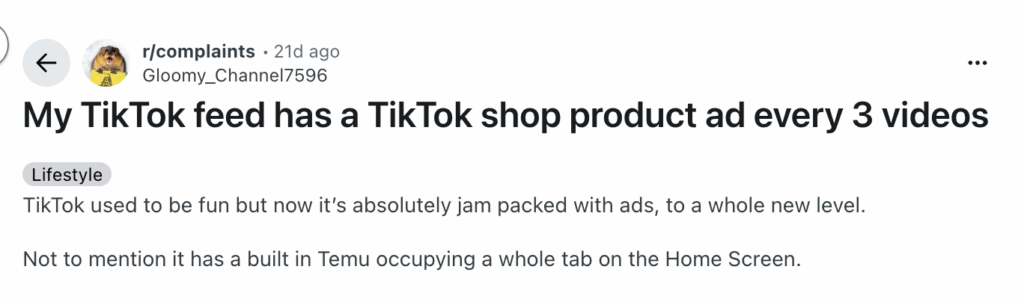
“My TikTok feed has a TikTok Shop product ad every 3 videos.” // Reddit.com
Another:
“At this point, TikTok isn’t even an entertainment app. It’s literally becoming a shopping app.”
What used to feel spontaneous now feels automatic. And what used to feel trustworthy now feels transactional.
The Creator Pivot: From Promotion to Pause
In response, a new creator behavior is emerging. Quiet, but growing.
Some are pulling affiliate links from their bios. Others are explaining their silence. “Unhaul” videos are replacing hauls. Disclaimers like “not sponsored, just like it” are being used as trust signals. And in early 2025, the rise of #NoBuy2025 & #DeInfluencing showed that this isn’t just about money. It’s about values.
“No Buy 2025 is trending on TikTok as users rethink their spending habits in the age of social media consumerism.”
The shift isn’t only about what creators are selling. It’s about what they’re showing.
In December 2025, longtime beauty influencer Jaclyn Hill (now Jaclyn Torrey) faced backlash after posting a TikTok complaining about low views. Despite her million-plus following, her videos were getting 30,000 views or less. She blamed the algorithm.
Viewers pointed to something else:
“Saying ‘I’m burnt out’ from posting Sephora hauls and GRWMs to employed people is insane.”
“I’m trying to buy formula. You’re buying handbags worth more than my mortgage.”
It wasn’t the complaint that triggered people. It was the context. Followers weren’t interested in algorithm gripes from someone showing off designer gifts and luxury skincare.
The same tone shift is surfacing elsewhere.
Mikayla Nogueira, known for her ultra-polished beauty reviews, has faced waves of skepticism over whether her Shop content is still rooted in real opinion. Her lash promotion saga from early 2023 still shadows her feed. In 2025, the vibe has evolved from did she lie? to do I trust any of this anymore?
Even Alix Earle, who still commands mass influence, isn’t immune. Recent closet tour content and “casual” GRWMs featuring multiple designer pieces have sparked subtle disengagement — not always backlash, but viewer fatigue. The parasocial bond that made her a phenomenon in 2023 doesn’t hit the same when every outfit is sponsored and every product is tagged.
Influence hasn’t disappeared. It’s just been devalued by saturation. And the creators noticing it first are the ones whose content used to feel personal.
Case in point: the creator behind Poor for Dummies recently posted a five-minute, unsponsored review of Magic Spoon’s cereal bars — and called them “the worst thing [he] had ever eaten.” He spit out bites on camera, winced through each flavor, and never once softened the verdict. The review was brutal. And honest.
Then it got weird.
Without watching the video, Magic Spoon apparently flagged the post as a high-performer and approved it for monetization. A “creator earns commission” banner appeared beneath a video actively trashing their product. As of this writing, the video has over 400,000 views.
No partnership. No gifting. Just a brand seeing views and opting in.
It’s a clear sign of how automation is now outpacing judgment — and why performance without context is a brand risk, not just a creator one.
TikTok Isn’t Built for Credibility
TikTok was made for unpredictability. It was where vulnerability, randomness, and niche communities could thrive side by side. But commerce doesn’t reward surprise. It rewards optimization.
As a result, the feed is flattening.
Product demos. Slideshow reviews. Repetitive hooks designed to move units. The chaos is being replaced by sales infrastructure.
“TikTok is now actually a shopping platform, not just a video app with a random tab trying to sell you stuff.”
Shop performance may be strong. But scroll behavior is shifting from discovery to defense. Users are skipping, muting, or disengaging from over-commercialized content. And creators can feel it too.
The Trust Erosion Is Real
This isn’t just about fatigue. It’s also about fallout.
In late 2025, the Better Business Bureau gave TikTok an “F” rating. Over 900 unresolved complaints were tied to Shop orders. That includes refund issues, product quality complaints, and scam-adjacent seller tactics.
And while TikTok makes it easy to sell, it offers little protection for creators who get burned. Many are still unaware that the FTC holds them responsible for misleading claims, especially in health and wellness. If a supplement goes sideways, it’s not just the brand that could be liable. It’s the person in the video.
Even Olive — who, once again, has no medical training and cannot read — could theoretically be liable if her affiliate link drove a sale that caused harm. The FTC won’t go after your dog… but depending on how bad the situation was, they may decide to dig into who runs the dog’s account.
Creators may still want to participate in the commerce ecosystem. But they’re waking up to the risks — both legal and reputational.
How Brands Can Partner Smarter in 2026
Getting on the right For You Page is no longer enough. If the product lands in the wrong hands, or the wrong tone, it doesn’t just get ignored. It can actively backfire.
Here’s how to do it better:
Prioritize product fit over follower count
Don’t chase reach for reach’s sake. Partner with creators who already talk about your category in ways that feel fluent. The question isn’t “Who has an audience?” — it’s “Who would use this even if we weren’t paying them?”
Don’t monetize content you haven’t watched
It sounds obvious, but the Magic Spoon moment proved otherwise. When Poor for Dummies posted a scathing, unpaid review of their cereal bars — literally calling them “the worst thing he had ever eaten” — Magic Spoon approved the video for monetization without watching it. A “creator earns commission” banner appeared beneath a video actively roasting their product.
Automation might be efficient. But it’s not strategy.
Ask for honesty — and mean it
The most credible posts right now are the ones that acknowledge nuance. If there are caveats or taste disclaimers, let the creator say that. Audiences respond to transparency. So do platforms.
Co-create, don’t over-control
Scripts are dead. So is influencer-as-spokesperson. The most effective content feels native to the creator’s voice, format, and community. If a creator needs to “break character” to deliver your CTA, you’ve already lost the moment.
Build for long-term alignment, not just a spike
One-off product drops and short-term commissions might move units. But they rarely build trust. Look for creators you can show up with repeatedly — across posts, platforms, and moments — so the audience sees consistency, not just conversion.
Final Thought
The feed is crowded. Every scroll is an offer. Every post is a pitch.
Which is why the most powerful thing a creator or a brand can do in 2026 might not be selling something.
It might be choosing not to.