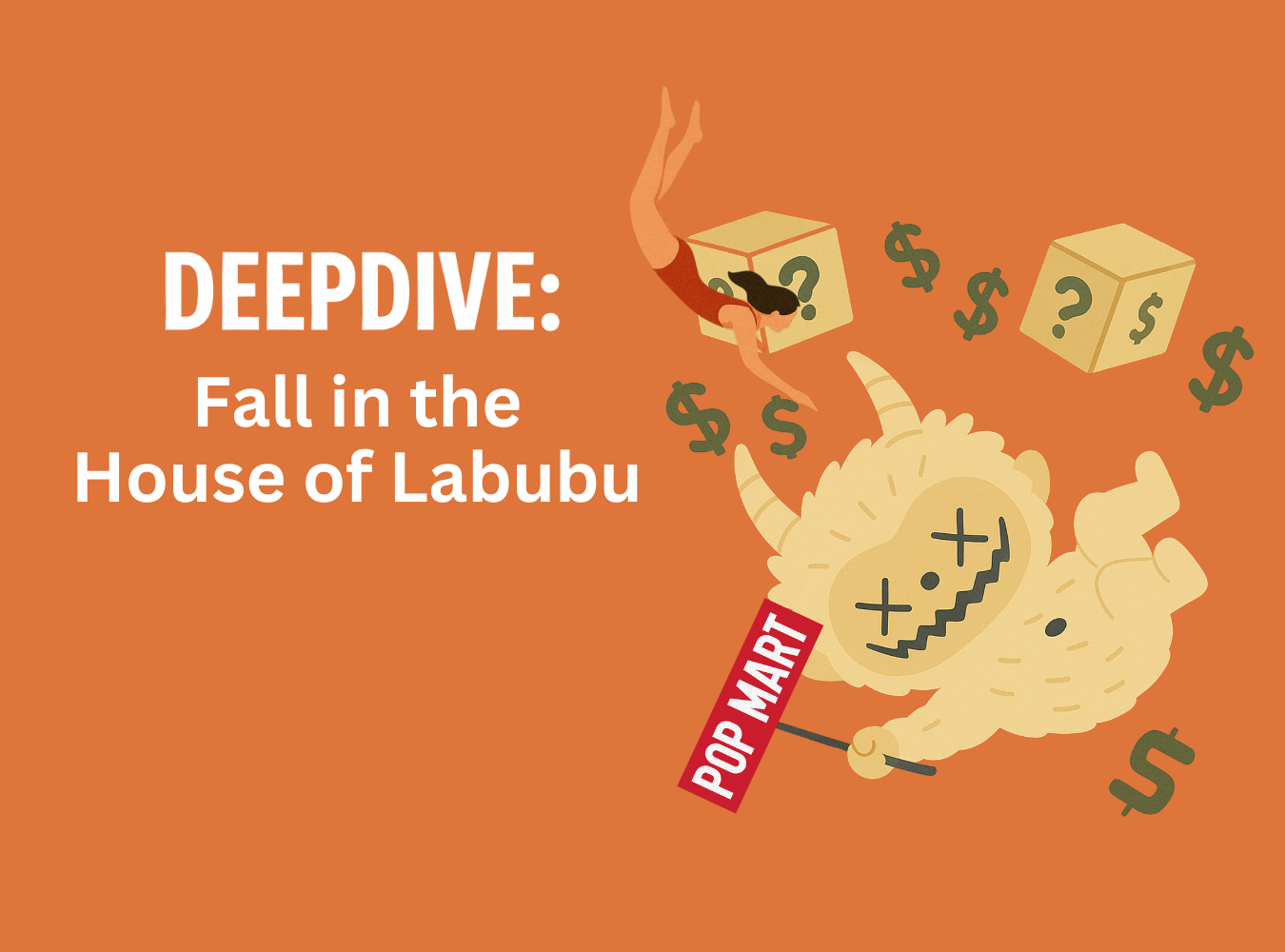
Labubu: What happens when the fandom cools, and the brand scrambles to keep the wheel turning?
This article is a follow-up to our “The Rise of Labubu” deep dive from July 2025. You can read it here.
In 2025, Labubu wasn’t just a toy. It was a flex. The bug-eyed gremlin from Pop Mart’s The Monsters series became the unofficial mascot of haul culture — fed by TikTok unboxings, Xiaohongshu stans, and resale prices that edged into sneaker territory. Labubu wasn’t for everyone. That was the whole point.
In early 2025, it was Pop Mart’s crown jewel. Blind boxes sold out in minutes. Resellers flipped plush toys like blue-chip assets. Fans didn’t just want the character. They wanted the chase.
Then the loop broke.
This isn’t a collapse story. It’s a transition — from cult status to corporate asset, from drop-driven phenomenon to something Pop Mart can control. The fandom is still alive. But the dynamics that made it viral are shifting. And now, Pop Mart is playing a very different game.
What’s Happening: The Heat’s Off — By Design
1. Pop Mart Killed the Resale Market to Please Fans
In 2025, Pop Mart ramped production to over 30 million Labubu plushes a month. The goal? Undercut resellers, expand access, and keep fans happy.
It worked — sort of. But killing scarcity also killed resale hype. A plush that used to flip for 500 yuan now barely clears 108. The resale bubble didn’t burst. Pop Mart popped it.
Investors noticed. JPMorgan flagged the cooling hype as a material risk. Pop Mart’s stock dropped 9% in September.
By giving fans what they wanted — more Labubu — the company broke the illusion of rarity. And in a fandom built on exclusivity, that illusion is everything.
2. Counterfeits Reframed What It Means to Own a Labubu
The real saturation wasn’t just Pop Mart’s fault. It was Lafufus — a flood of high-quality knockoffs that started eating market share in late 2024 and haven’t stopped.
In the UK alone, fake Labubus accounted for 90% of the £3.5M in counterfeit toys seized this year. But many buyers know they’re fake — and don’t care. On TikTok and Xiaohongshu, Lafufus are part of dupe culture: cheap, aesthetic, and close enough for the feed.
This isn’t a piracy problem. It’s a perception shift.
But there is risk. In November, the U.S. Consumer Product Safety Commission issued a formal warning after discovering counterfeit Labubus with choking hazards and unsafe materials. Customs seizures are climbing. Pop Mart sued California-based 7-Eleven stores for carrying illegal stock. Earlier this year, in-person sales were paused in the UK after brawls broke out over product drops.
This has officially moved beyond IP enforcement. It’s now a brand safety issue.
3. Scarcity Culture Doesn’t Survive Mass Adoption
Labubu fandom wasn’t about product. It was about mechanics — the thrill of the blind box, the adrenaline of the unboxing, the status hit of the resale win. It was designed for social performance.
That loop doesn’t survive ubiquity. Once Labubu became easy to buy, it stopped being worth posting. Pop Mart thought access would drive loyalty. But platform-native fandoms are driven by differentiation, not distribution.
Labubu didn’t vanish. It just stopped signaling value.
As Xiaoman, Senior Strategist at ListenFirst, put it:
“Without Disney-level storytelling or Lego-scale world-building, [Pop Mart’s] long-term stability isn’t guaranteed.”
Brand Implications: From Drops to Stewardship
Pop Mart isn’t flailing. It’s just outgrowing the mechanics that made it viral.
Q3 2025 earnings were strong: U.S. sales up 1,265% YoY, China up nearly 190%. But the bulk of that momentum still comes from Labubu. That’s not a win. It’s a warning.
- Oversaturation is brand erosion
Labubu is veering into Funko Pop territory — omnipresent, over-licensed, emotionally flattened. The thing that made it matter (novelty) can’t survive overexposure. - Tactics aren’t a growth plan
The mini Labubu drop in August pushed stock up 14% — briefly. But smaller SKUs, new packaging, and seasonal colorways don’t build long-term equity. They’re content, not strategy. - No narrative spine = shallow fandom
Pop Mart’s world is visual, not emotional. There’s no lore, no character development, no story architecture to root deeper engagement. Unlike Disney, Sanrio, or even Lego, Pop Mart hasn’t built a universe — just a shelf.
Platform POV: Dupe Culture Is Winning the Algorithm
Labubu’s rise was algorithmically sound. Visually distinct. Blind box–friendly. Optimized for the feed.
But its decline coincides with another shift: the normalization of dupes.
Dupe perfumes, replica bags, fake Stanley cups. On Xiaohongshu, dupe hauls routinely match or outperform original drops. Lafufus aren’t a counterfeit crisis. They’re the logical endpoint of a platform ecosystem that celebrates visual parity over provenance.
Pop Mart is trying to pivot:
- Media expansion: Animated series and an in-house studio are in development
- Physical immersion: The Pop Land theme park in Beijing opens the door to IRL worldbuilding
- IP diversification: Pop Mart is developing 5–10 new characters with Labubu-level potential
- Global expansion: U.S. and EU are now breakout growth markets
But product volume isn’t enough. To survive the dupe era, Pop Mart has to offer something Lafufus can’t fake: emotional specificity, narrative depth, character arcs. Otherwise, it’s just a different SKU.
Key Takeaways for Marketers
- Exclusivity drives the flex. When everyone can own it, no one needs to post it.
- Counterfeits are cultural objects. Lafufus mimic replica luxury: aesthetic, accepted, and algorithm-approved.
- Safety now shapes brand equity. Regulatory risk around fakes means trust is now part of the marketing equation.
- Virality is a sprint. IP is a marathon. You need scarcity to start the story. But story is what keeps people around.
Final Thought
Labubu didn’t flop. It evolved.
Pop Mart built a fandom and a case study. The real question isn’t whether Labubu can keep selling. It’s whether platform-native characters can survive outside the hype loop. Not as toys. As stories.