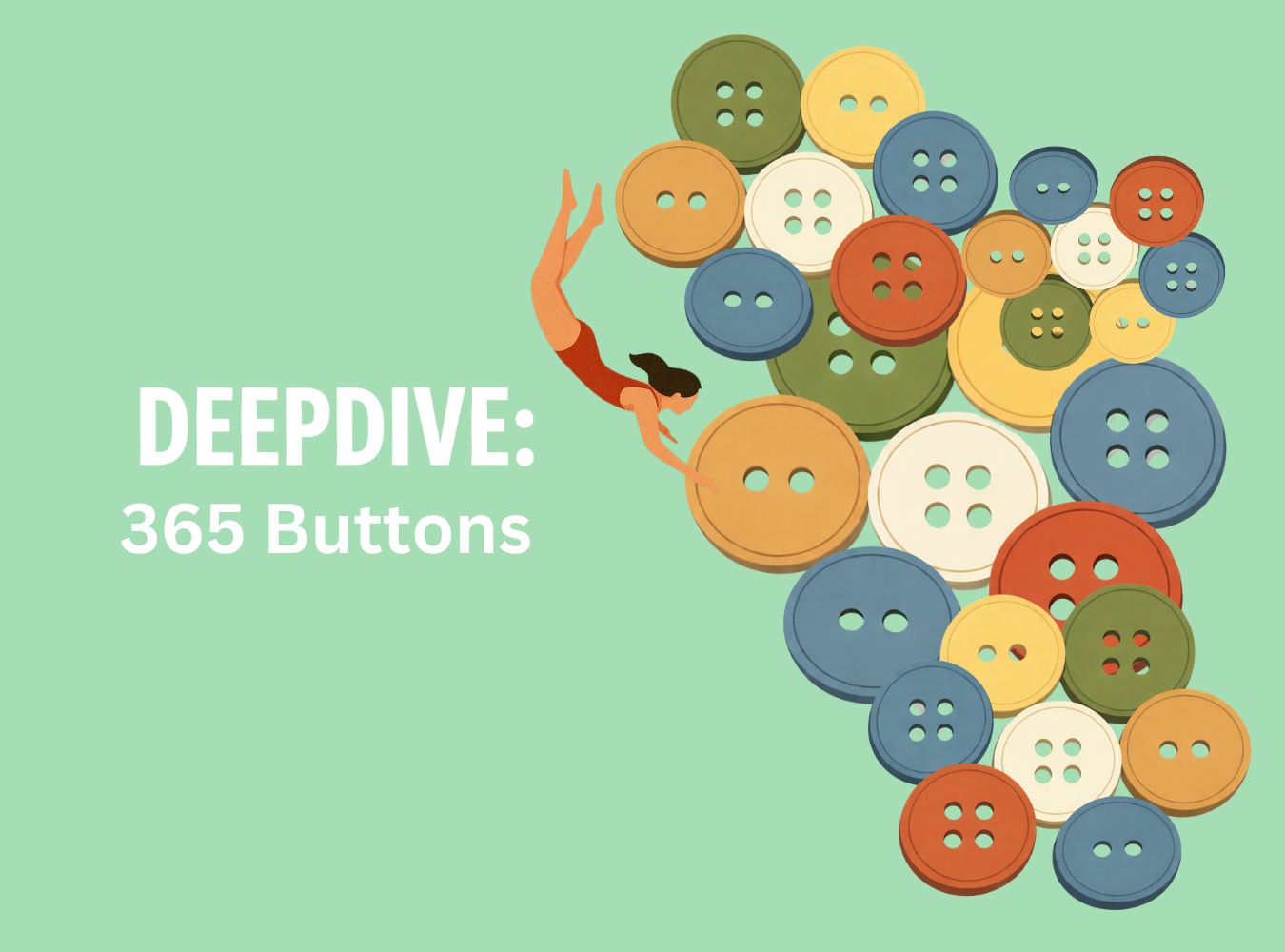
365 Buttons, and How It Actually Only Has To Make Sense To Me.
The 365 Buttons meme is more than a TikTok bit. It’s a quiet rejection of platform logic, productivity culture, and overexplained marketing. Brands should pay attention to what it signals: the return of the personal, the offline, and the unapologetically inexplicable.
@poptrish #tamara #365buttons #2026 #rebrand long live tamara and i wonder what they buttons are for ?? I was very intruiged before i even realized that was the whole comment section
♬ original sound – trish’s fish –
A Button A Day Keeps the Algorithm Away
The 365 Buttons meme wasn’t designed to go viral. It wasn’t designed at all.
It started, like many things do, with a TikTok comment. In response to a video about New Year’s rituals, a user named Tamara (@flylikeadove) casually mentioned she was collecting 365 buttons — one for each day of the year — to “help me be aware of the days and time passing.” When pressed on what she meant, how the buttons would work, or what she’d do with them, Tamara responded:
“It actually only has to make sense to me for me to do it, and I don’t feel like explaining it to anyone else.”
The comment was screenshotted, remixed, and memeified. People quoted it over neon “Brat”-pink backdrops, cited it as a personal philosophy, and began their own mystifying button collections. Offline crafts and analog hoarding followed. The Philadelphia Eagles posted a box of buttons to their TikTok with no further explanation.
But beneath the absurdity was something stickier: a yearning for rituals that don’t require optimization. In a cultural moment dominated by productivity apps, accountability hacks, and habit-tracking TikTok, 365 Buttons feels like a middle finger to it all. Not quite anti-consumer — Tamara did buy the buttons — but certainly anti-performative.
365 Buttons: Why Brands Should Care
The meme marks a shift in how younger audiences are relating to meaning-making. It’s not about aspiration or identity performance. It’s an aspirational desire to reclaim a sense of private logic in a world that wants everything to be content.
Brands, especially those in lifestyle, fashion, wellness, and food, should take note. We’re entering a cycle in which audiences crave artifacts, not just aesthetics.
What’s resonating:
- Drops that don’t come with explainer decks
- Merch that feels like an inside joke with yourself
- Offline-first activations that prioritize experience over shareability
Not everything has to be backstopped by a mission statement. In fact, mystery might be a better marketing strategy in 2026 than transparency.
365 Buttons: Platform Logic vs. Personal Ritual
For years, platforms have conditioned us to narrativize and justify every behavior: why you bought this product, what morning routine you follow, how this niche hobby changed your life. “What’s the why?” became the default marketing framework — and consumers internalized it, too.
The 365 Buttons meme is a rejection of that logic. It says: maybe I just want to do this because I want to. Maybe I don’t want to explain it. Maybe you don’t get to know.
It joins a lineage of trends that are resistant to platform logic:
- “Girl Dinner” as chaotic personal pleasure, not meal planning
- The Charli XCX Brat era’s aggressive self-reference and anti-brandness
- “Corecore” edits that refuse clean narratives
These trends aren’t about randomness. They’re about recentering the individual as the only required audience. It’s a powerful shift — and a tough one for brands to adapt to.
This is also where we see the arrival of post-cringe Gen Z — a cohort less concerned with curating perfect taste and more interested in doing what feels good, even if it looks absurd. In ListenFirst’s deep dive on post-cringe culture, the throughline was clear: Gen Z isn’t performing for approval anymore. They’re performing for themselves. The earnestness of niche hobbies, fandom in-jokes, chaotic edits, and yes — collecting buttons — signals a move away from shame and toward unfiltered enthusiasm.
There’s a real power in not caring how something looks. Not because you’ve mastered irony, but because you’ve moved past it. Post-cringe isn’t aesthetic detachment — it’s aesthetic immunity. The logic of “it makes me happy” wins.
That’s what makes Tamara such a striking figure. She didn’t try to frame her button ritual as cute, deep, healing, or even quirky. She didn’t try to make it legible. She didn’t try at all — and that’s exactly what gave the meme its momentum.
It’s a sharp contrast to a decade of digital behavior where trying too hard was the ultimate sin. Where TikTok’s engagement-hungry algorithm doesn’t differentiate between praise and mockery — only velocity. And where public pile-ons have turned sincere effort into social risk.
Tamara offered something different: a refusal to over-articulate. A quiet personal act, posted without the usual self-branding or strategic framing. In a platform ecosystem that rewards spectacle and punishes vulnerability, that choice felt radical.
What the Platforms Won’t Tell You
The rise of 365 Buttons and its refusal to explain itself doesn’t play out the same across every platform. The logic of “because I like it” runs directly against the grain of most engagement-optimized environments — and that’s where it gets interesting.
On TikTok, ambiguity still works — if it’s visually or emotionally sticky. Tamara’s comment exploded precisely because it created friction: people had to ask what it meant. TikTok rewards curiosity, not clarity. If a post sparks enough confusion or resonance, the algorithm pushes it regardless of whether the tone is celebratory or mocking. That’s part of the risk — and the magic.
On Instagram, the trend is harder to pull off. Instagram’s visual culture is still rooted in context, cohesion, and captioning. A feed post with a box of buttons and no story likely reads as an aesthetic glitch. That doesn’t mean it’s impossible — just that the weirdness has to be more styled, less spontaneous.
Meanwhile, Pinterest is having a quiet renaissance as the moodboard platform for analog life. Rituals, collections, visual journaling, and off-grid habits all perform well there — especially when disconnected from identity performance. The logic of “this is for me” fits Pinterest’s user intent better than any other platform right now.
Understanding platform psychology is more important than ever — especially when playing with trends that subvert it.
Brands are also recognizing where culture on TikTok actually happens: in the comments. The viral arc of 365 Buttons wasn’t driven by content strategy — it was sparked by a single comment that invited interpretation, misreading, and remix. In response, we’re seeing social teams shift from planned storytelling to opportunistic presence. They’re jumping into the conversation even when they weren’t explicitly invited — stitching, replying, or just reacting in real time to inject their brand into the meme’s momentum.
It’s not just reactive. It’s cultural fluency. Being able to read the tone of a thread, contribute something additive (or weird), and walk away without trying to hijack the narrative. In 2026, comment sections are creative territory — and brands that treat them that way are better positioned to move with culture instead of behind it.
A Personal Note: What About the Dog?
When I was planning my first tattoo, I had this idea for a wrist wrap: two words on each side, small and simple. One end would say Good Bones — after my favorite poem. The other, God Given — after one of my favorite Nine Inch Nails songs. The words fit together in a way that felt poetic to me. Not loud, not symbolic, not a statement piece. Just a quiet design I liked.
At a party, someone brought up tattoos, and I shared the idea. Not looking for feedback, just adding to the conversation. But one guy in the circle got this weirdly intense look on his face and asked, “Okay, but what does that mean to you? What’s the deeper meaning?” Same energy as when someone asks you to name five songs from the band on your t-shirt.
I told him, “No deep meaning. I just like the combo.” He laughed as if I had somehow embarrassed myself with that response. I rolled my eyes and walked away.
What stuck with me wasn’t the conversation — it was the expectation. Why did I owe this guy an explanation for something he had nothing to do with? Why is liking something not a good enough reason anymore?
That’s the same energy Tamara got when she said she was collecting 365 buttons. People couldn’t stop asking what they were for, what she was going to do with them, what the point was. And when she finally responded — “It only has to make sense to me” — it hit. Because it wasn’t just a clapback. It was a boundary.
Ironically (or not), the guy didn’t have any tattoos. Maybe he was so caught up in something having the most profound meaning that he couldn’t commit to something he just liked. Thus, no one else was allowed to either.
Random guys at parties. Random commenters on the internet. Same energy we’re not entertaining in 2026. The youth are done explaining themselves to people who were never going to get it in the first place. And I am here for it.
I never did get that tattoo. I got a watercolor-style portrait of my dog instead, and a small wave I did myself on my wrist bone. Every once in a while, I get asked about the wave, and while I could make up some deep meaning about how it represents the eb and flow of life, in reality, I just like it. And it reminds me of the song “Emoji of a Wave” by John Mayer—another song in my top 5.
No one asks about the dog.
How Brands Can Jump On It Fast
You don’t need a button line or a cryptic manifesto to play in this space. But you do need to get comfortable with meaning that lives outside of explanation. Here’s how brands could respond:
- Beauty: A woman uses a bold lipstick shade while her friend asks, “Why that color?” She shrugs and smiles: “It’s my favorite.”
- Food & Beverage: A coffee shop customer confidently orders a unique drink, like Starbucks’ olive oil coffee. Their friend reacts with confusion. The customer smiles and says, “I just like how it tastes.”
- Fashion: A brand drops a limited-run item with no context, modeled in intentionally eclectic fits. Caption: “No backstory. No trend. Just felt right.”
- Tech/Gaming: A campaign for a retro handheld console where players show off how they modded it — stickers, scratches, tape — with no voiceover or explanation. Just vibes and button clicks.
These aren’t full campaigns — they’re tone shifts. The vibe should center on individual tastes and preferences that bring joy to the consumer, even if no one else gets it. Let audiences project their own logic onto the product.
Key Takeaways for Marketers
- Design for ambiguity. Not everything needs a brand manifesto. Sometimes, the product is the message.
- Respect private logic. Audiences are creating meaning outside of algorithms. Don’t try to co-opt it.
- Tap into tactility. Rituals that live offline — stickers, buttons, notebooks, objects — have regained cultural currency.
- Know when not to explain. If your campaign needs a 12-slide carousel to make sense, it might not.
- Be weirder. But let the weirdness emerge organically, not as a stunt.
A Final Thought
What happens when culture stops offering a reason? The 365 Buttons meme doesn’t answer that — it doesn’t try to. It just quietly insists: this matters to me. That’s enough.